Year 10 (ages 14–15, Grade 9 in the US) · Languages · GCSE themes, part 1 · Lesson 1
Describing yourself and others
Describing appearance and personality in French using être and avoir, adjective agreement (masculine, feminine, plural), adjective position, and intensifiers such as très, assez and un peu.
Exam boards: this lesson matches the AQA and Pearson Edexcel GCSE languages courses. Check which course your school follows.
8-minute video lesson
Teaching, worked examples and 20 practice questions solved step by step.
Watch free for a monthWhat your child will learn
- Use être and avoir to describe people
- Make adjectives agree
- Place adjectives correctly
- Add intensifiers and detail
The method
- Choose the verb: être (is) for personality; avoir (has) for eyes, hair, age.
- Make the adjective agree: add -e for feminine, -s for plural.
- Most adjectives go after the noun.
- Add an intensifier: très, assez, un peu.
Key words: adjective, agreement, être, avoir, intensifier.
Worked examples
Worked examples from the lesson, with every step.
Question 1
Translate: She is tall and funny.
- Step 1: she is → «elle est»
- Step 2: feminine: «grande», «drôle» (no change)
Answer: «Elle est grande et drôle.»
Question 2
Translate: I have short brown hair.
- Step 1: «J'ai les cheveux»
- Step 2: masculine plural: «courts et bruns»
Answer: «J'ai les cheveux courts et bruns.»
Question 3
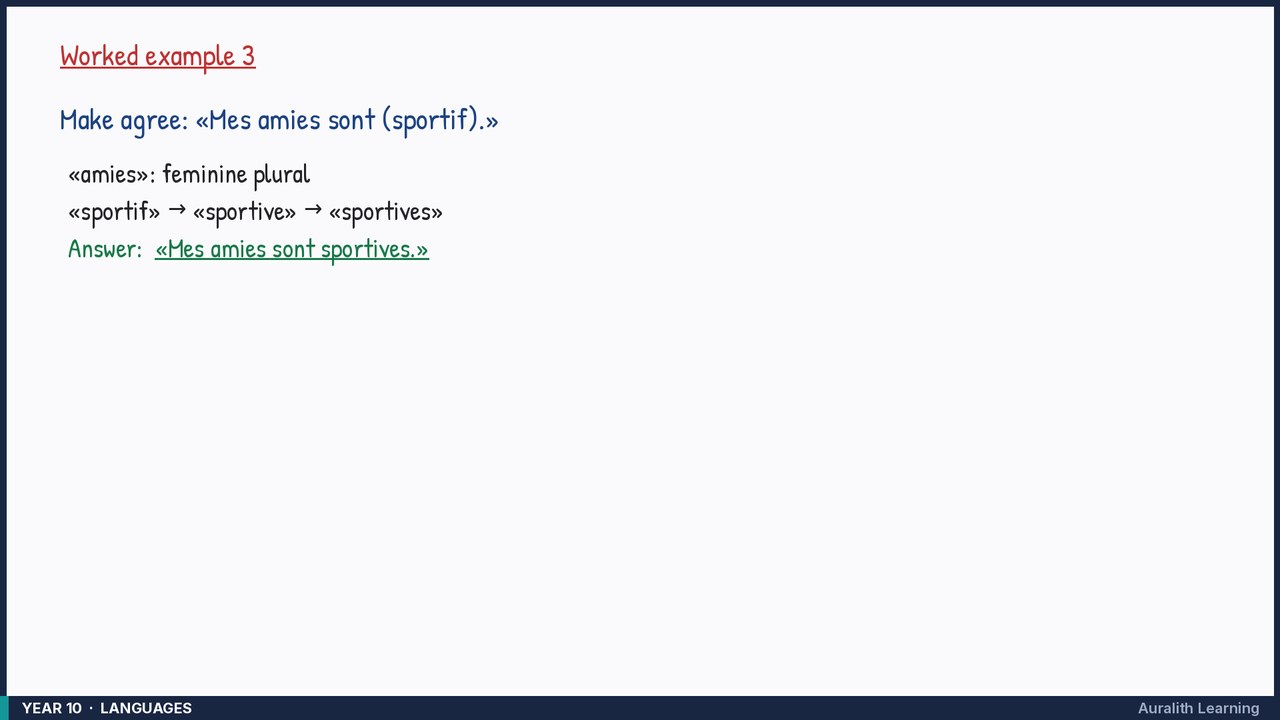
Make agree: «Mes amies sont (sportif).»
- Step 1: «amies»: feminine plural
- Step 2: «sportif» → «sportive» → «sportives»
Answer: «Mes amies sont sportives.»