Year 10 (ages 14–15, Grade 9 in the US) · Languages · GCSE themes, part 1 · Lesson 13
Describing a past celebration: perfect and imperfect
Describing a birthday or celebration in the past in French by combining the perfect tense (single completed actions) with the imperfect tense (descriptions, what was happening, what used to happen), and forming the imperfect.
Exam boards: this lesson matches the AQA and Pearson Edexcel GCSE languages courses. Check which course your school follows.
8-minute video lesson
Teaching, worked examples and 20 practice questions solved step by step.
Watch free for a monthWhat your child will learn
- Form the imperfect tense
- Choose between perfect and imperfect
- Describe a past celebration
- Link past events with sequencing words
The method
- Imperfect: «nous» present stem (drop -ons) + -ais, -ais, -ait, -ions, -iez, -aient.
- être is irregular: «j'étais», «c'était».
- Imperfect: descriptions, weather, feelings, ‘used to’, ‘was …ing’.
- Perfect: single completed events: «j'ai reçu», «nous sommes allés».
Key words: imperfect tense, perfect tense, description, habit, c'était.
Worked examples
Worked examples from the lesson, with every step.
Question 1
Form the imperfect of «manger» (je).
- Step 1: «nous mangeons» → «mange-»
- Step 2: «-ais» → «je mangeais»
Answer: «je mangeais»
Question 2
Perfect or imperfect? ‘It was sunny.’
- Step 1: Weather / description
- Step 2: Imperfect: «Il faisait beau.»
Answer: imperfect — «Il faisait beau.»
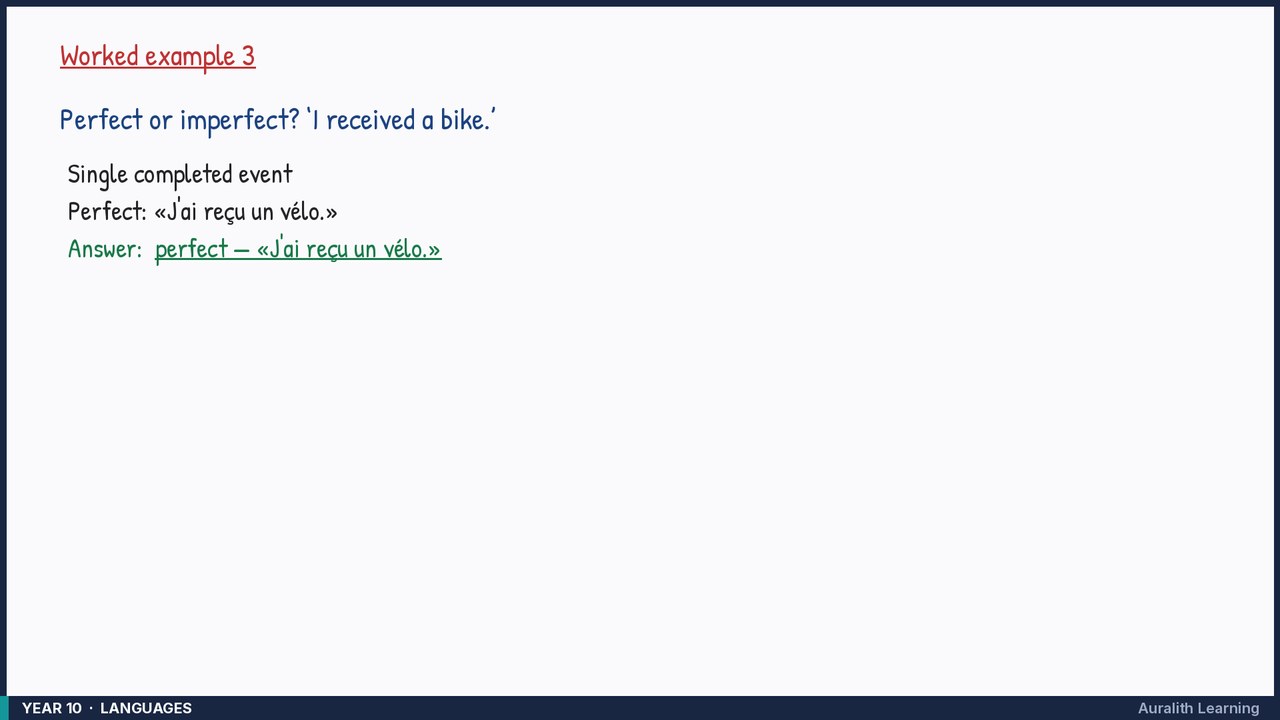
Question 3
Perfect or imperfect? ‘I received a bike.’
- Step 1: Single completed event
- Step 2: Perfect: «J'ai reçu un vélo.»
Answer: perfect — «J'ai reçu un vélo.»