Year 10 (ages 14–15, Grade 9 in the US) · Languages · GCSE themes, part 1 · Lesson 3
Friendship and what makes a good friend
Describing friends and friendship in French, using qui and que to join sentences, giving opinions with je pense que and à mon avis, and using the conditional phrase un bon ami devrait.
Exam boards: this lesson matches the AQA and Pearson Edexcel GCSE languages courses. Check which course your school follows.
8-minute video lesson
Teaching, worked examples and 20 practice questions solved step by step.
Watch free for a monthWhat your child will learn
- Describe a best friend
- Use qui and que correctly
- Give opinions
- Say what a good friend should do
The method
- «qui» = who / which (the subject of the next verb).
- «que» = whom / that (the object; another subject follows).
- Opinions: «Je pense que…», «À mon avis…».
- «Un bon ami devrait…» = a good friend should…
Key words: relative pronoun, qui, que, opinion, conditional.
Worked examples
Worked examples from the lesson, with every step.
Question 1
Join with qui: «J'ai une amie. Elle est très drôle.»
- Step 1: «Elle» is the subject of «est» → «qui»
- Step 2: «J'ai une amie qui est très drôle.»
Answer: «J'ai une amie qui est très drôle.»
Question 2
Join with que: «C'est un film. Je préfère ce film.»
- Step 1: Another subject («je») follows → «que»
- Step 2: «C'est le film que je préfère.»
Answer: «C'est le film que je préfère.»
Question 3
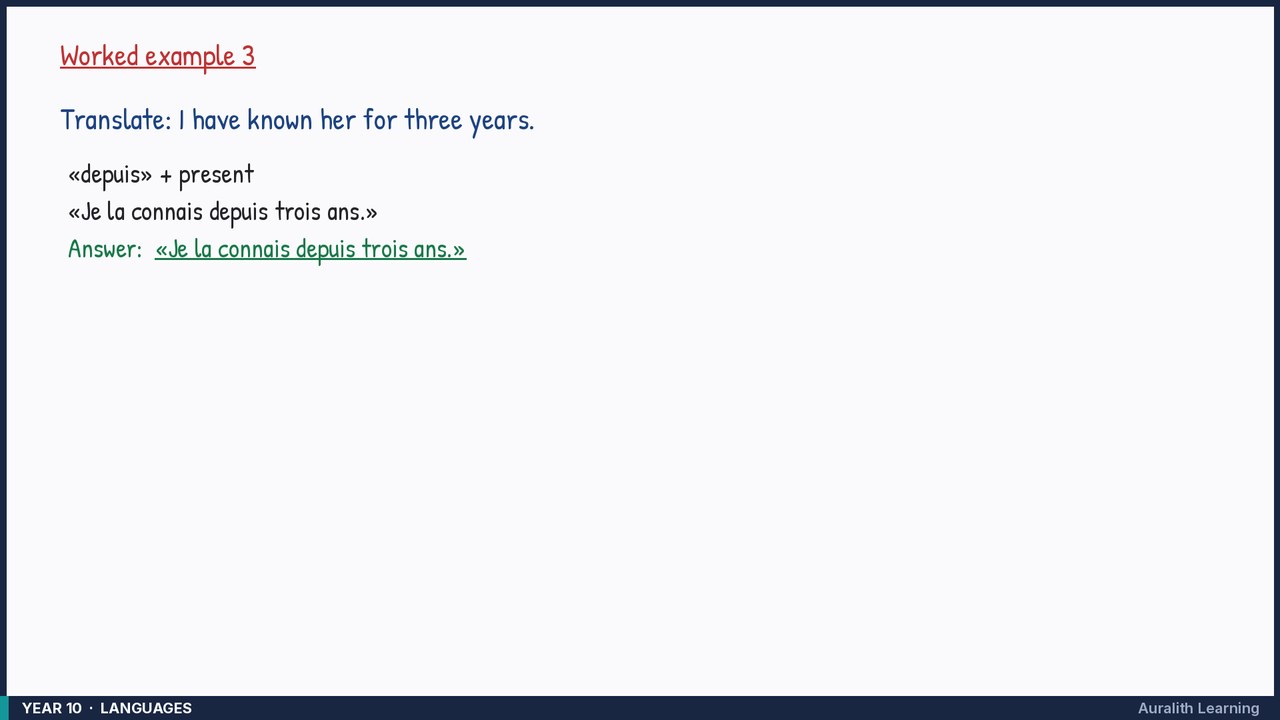
Translate: I have known her for three years.
- Step 1: «depuis» + present
- Step 2: «Je la connais depuis trois ans.»
Answer: «Je la connais depuis trois ans.»