Year 10 (ages 14–15, Grade 9 in the US) · Languages · GCSE themes, part 1 · Lesson 11
Sport: the perfect tense with être
Talking about sport and past events in French using the perfect tense with être: the verbs that take être, agreement of the past participle with the subject, and reflexive verbs in the perfect tense.
Exam boards: this lesson matches the AQA and Pearson Edexcel GCSE languages courses. Check which course your school follows.
8-minute video lesson
Teaching, worked examples and 20 practice questions solved step by step.
Watch free for a monthWhat your child will learn
- Identify verbs that take être
- Form the perfect tense with être
- Make the participle agree
- Use reflexive verbs in the past
The method
- About 16 verbs of movement / change take être (MRS VANDERTRAMP).
- être (present) + past participle: «je suis allé».
- Agree with the subject: +e (f), +s (pl): «elle est allée».
- All reflexive verbs use être: «je me suis entraîné(e)».
Key words: être, perfect tense, agreement, reflexive, MRS VANDERTRAMP.
Worked examples
Worked examples from the lesson, with every step.
Question 1
Translate: I went to the swimming pool. (boy)
- Step 1: «aller» takes être
- Step 2: «Je suis allé à la piscine.»
Answer: «Je suis allé à la piscine.»
Question 2
Translate: She arrived at the stadium.
- Step 1: «arriver» + être
- Step 2: feminine: «arrivée»
Answer: «Elle est arrivée au stade.»
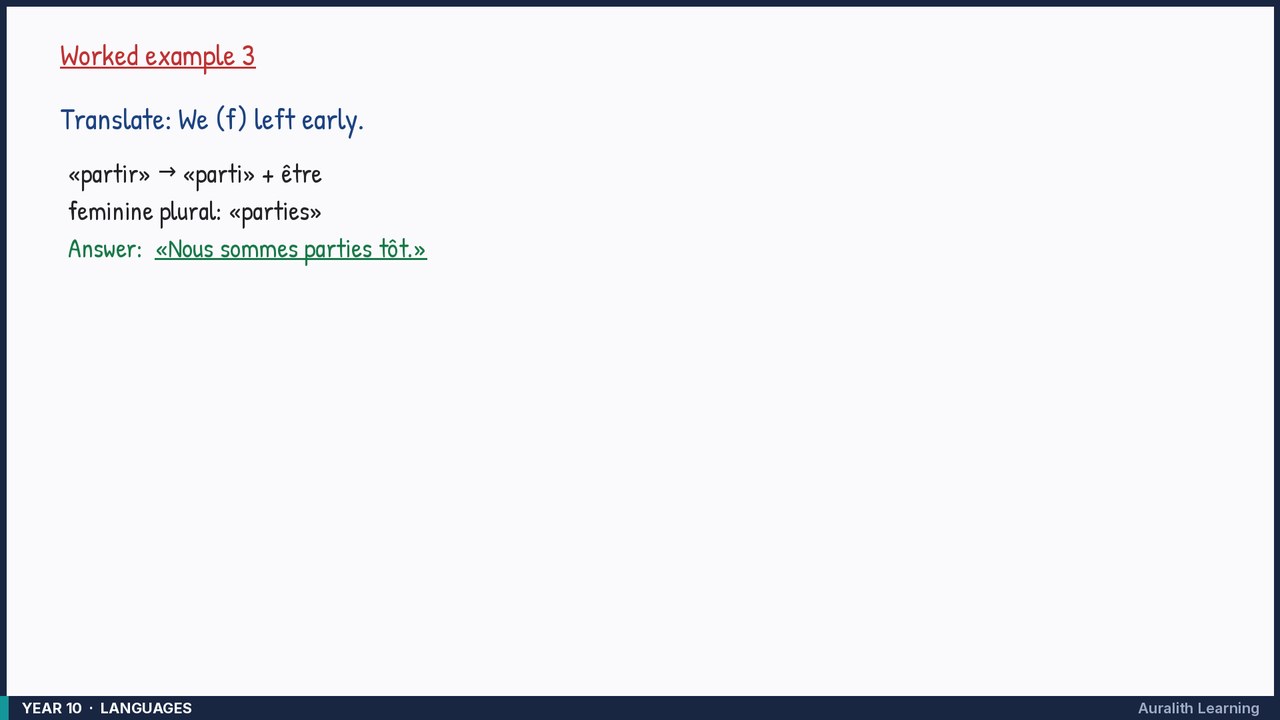
Question 3
Translate: We (f) left early.
- Step 1: «partir» → «parti» + être
- Step 2: feminine plural: «parties»
Answer: «Nous sommes parties tôt.»