Year 10 (ages 14–15, Grade 9 in the US) · English · AQA poetry: Power and Conflict · Lesson 2
The Prelude and My Last Duchess: nature's power and a duke's control
Two AQA Power and Conflict poems: Wordsworth's extract from ‘The Prelude’, where a boy's confidence is crushed by the power of a mountain, and Browning's ‘My Last Duchess’, where a duke reveals his need to control his wife.
Exam boards: this lesson matches the AQA GCSE English courses. Check which course your school follows.
9-minute video lesson
Teaching, worked examples and 20 practice questions solved step by step.
Watch free for a monthWhat your child will learn
- Analyse how Wordsworth presents the power of nature
- Analyse how Browning presents a controlling, powerful man
- Explain how form and structure create meaning
- Compare the two poems
The method
- Track how the speaker's feelings change.
- Pick quotations at the turning points.
- Name the method and its effect.
- Link to context.
- Compare the kinds of power.
Key words: blank verse, dramatic monologue, enjambment, sublime, rhyming couplets.
Worked examples
Worked examples from the lesson, with every step.
Question 1
What does ‘an act of stealth / And troubled pleasure’ show about the boy?
- Step 1: He knows he is doing something secret and wrong.
- Step 2: An oxymoron: he enjoys it but feels guilty.
Answer: he enjoys the adventure but feels guilty
Question 2
Why does the mountain seem to follow the boy?
- Step 1: As he rows away, more of the peak comes into view behind a nearer ridge.
- Step 2: His guilt makes it seem alive and threatening.
Answer: it seems to grow as he rows, and his guilt makes it feel alive
Question 3
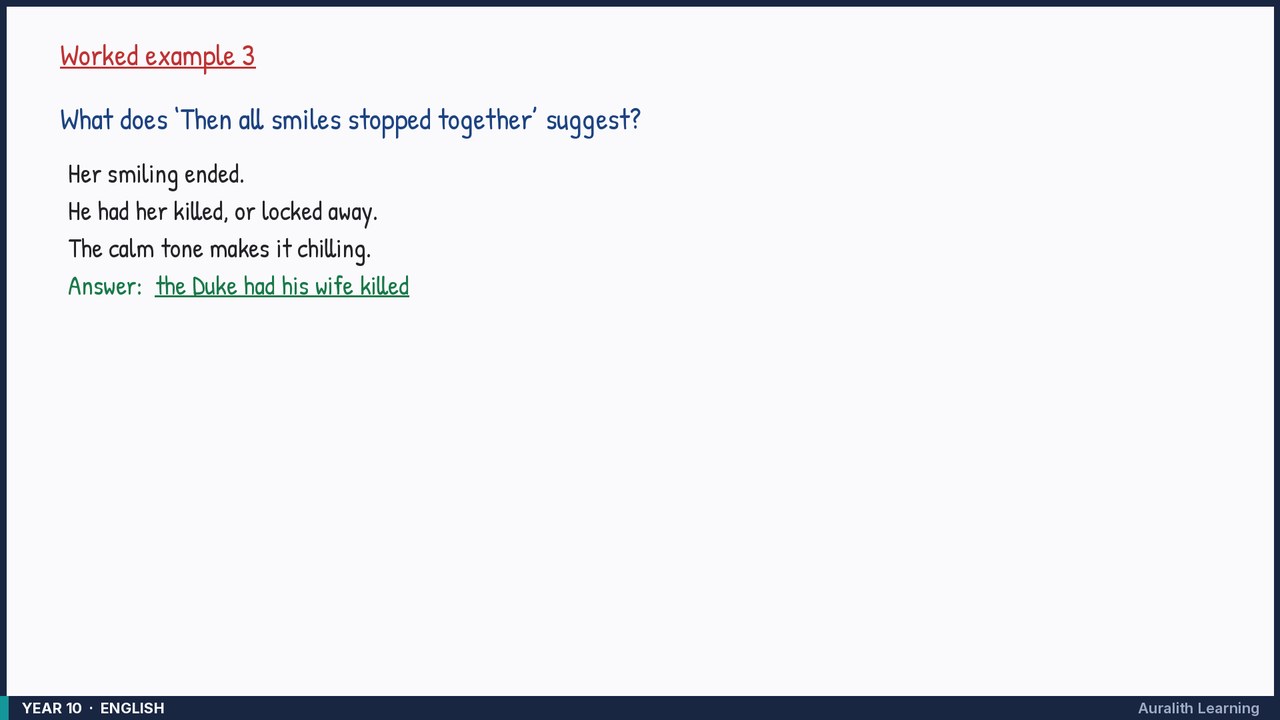
What does ‘Then all smiles stopped together’ suggest?
- Step 1: Her smiling ended.
- Step 2: He had her killed, or locked away.
- Step 3: The calm tone makes it chilling.
Answer: the Duke had his wife killed