Year 10 (ages 14–15, Grade 9 in the US) · English · AQA poetry: Power and Conflict · Lesson 4
Modern conflict poems: Bayonet Charge, Remains, Poppies, War Photographer and Kamikaze
What happens in five modern AQA Power and Conflict poems about war and its effects, the key methods each poet uses, and which poems make strong comparisons. Because these poems are still in copyright, learn their exact quotations from your own anthology.
Exam boards: this lesson matches the AQA GCSE English courses. Check which course your school follows.
9-minute video lesson
Teaching, worked examples and 20 practice questions solved step by step.
Watch free for a monthWhat your child will learn
- Summarise five modern conflict poems
- Explain each poet's viewpoint and key methods
- Choose good pairs of poems to compare
- Select your own quotations from the anthology
The method
- Who is speaking, and what happens?
- What is the poet's attitude to conflict?
- Which method stands out most?
- Which poem would compare well with it?
- Pick two short quotations from your anthology.
Key words: perspective, trauma, guilt, enjambment, narrative voice.
Worked examples
Worked examples from the lesson, with every step.
Question 1
What is the main conflict in ‘Remains’ after the soldier comes home?
- Step 1: He helped shoot a looter who may have been unarmed.
- Step 2: He sees the man in his memory and dreams.
Answer: an inner conflict: his guilt and trauma
Question 2
Whose perspective is ‘Poppies’ written from, and why does that matter?
- Step 1: A mother at home.
- Step 2: It shows the cost of war for families, not just soldiers.
Answer: a mother's; it shows war's effect on those left behind
Question 3
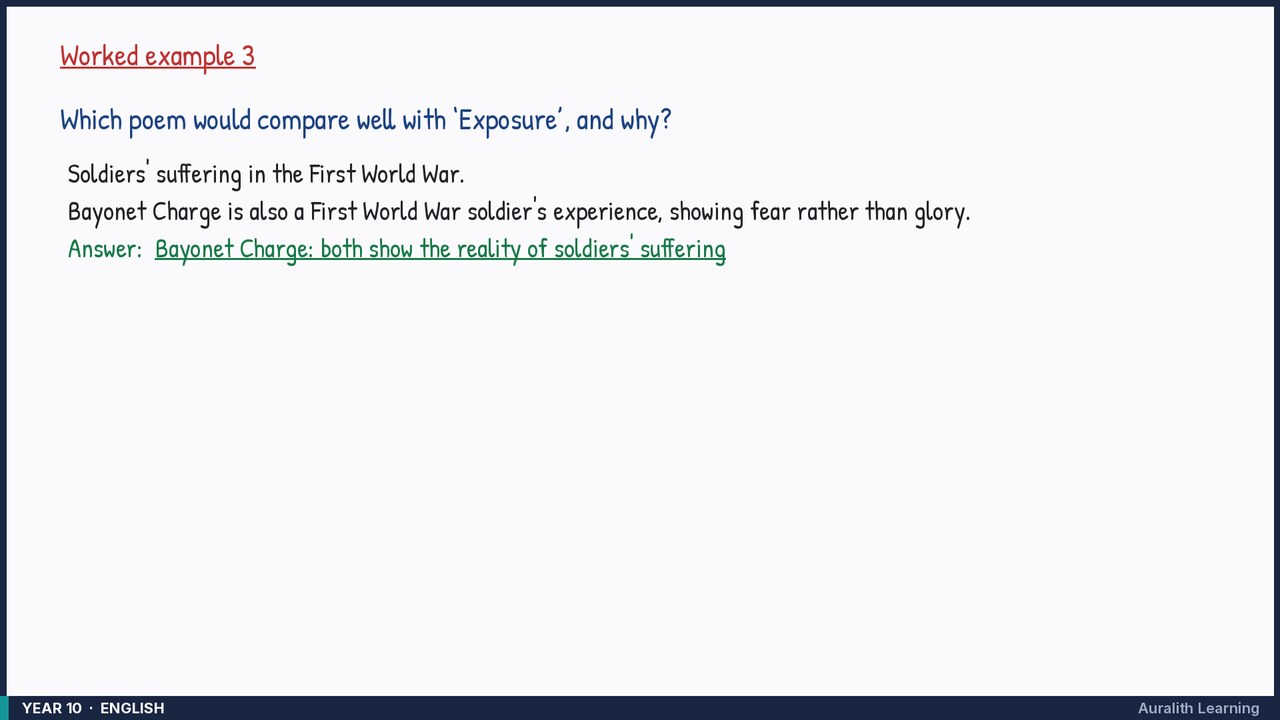
Which poem would compare well with ‘Exposure’, and why?
- Step 1: Soldiers' suffering in the First World War.
- Step 2: Bayonet Charge is also a First World War soldier's experience, showing fear rather than glory.
Answer: Bayonet Charge: both show the reality of soldiers' suffering