Year 10 (ages 14–15, Grade 9 in the US) · English · AQA poetry: Power and Conflict · Lesson 3
The Charge of the Light Brigade and Exposure: two views of war
Two AQA Power and Conflict poems about soldiers: Tennyson's ‘The Charge of the Light Brigade’, which honours the bravery of cavalrymen sent on a mistaken charge in the Crimean War, and Wilfred Owen's ‘Exposure’, which shows soldiers in the First World War being killed by the cold while ‘nothing happens’.
Exam boards: this lesson matches the AQA GCSE English courses. Check which course your school follows.
9-minute video lesson
Teaching, worked examples and 20 practice questions solved step by step.
Watch free for a monthWhat your child will learn
- Analyse how Tennyson presents bravery and the horror of war
- Analyse how Owen presents the suffering and futility of war
- Explain how rhythm, repetition and rhyme create meaning
- Compare the poets' attitudes to war
The method
- Identify the poet's attitude to war.
- Find quotations about the soldiers and the enemy.
- Analyse rhythm, repetition and rhyme.
- Link to context: when and why each poem was written.
- Compare the attitudes.
Key words: dactylic, refrain, half-rhyme, futility, personification.
Worked examples
Worked examples from the lesson, with every step.
Question 1
What does ‘Theirs not to reason why, / Theirs but to do and die’ show?
- Step 1: Soldiers must obey without questioning.
- Step 2: Repetition of ‘Theirs’ and the rhyme ‘why/die’.
- Step 3: Tennyson admires their duty, but the rhyme links obedience with death.
Answer: soldiers obeyed without question, even to their deaths
Question 2
How does the rhythm of ‘The Charge of the Light Brigade’ affect the reader?
- Step 1: Dactyls: one stressed beat and two unstressed, like hooves.
- Step 2: It feels fast and exciting, carrying us into the charge.
Answer: it sounds like galloping horses and builds excitement
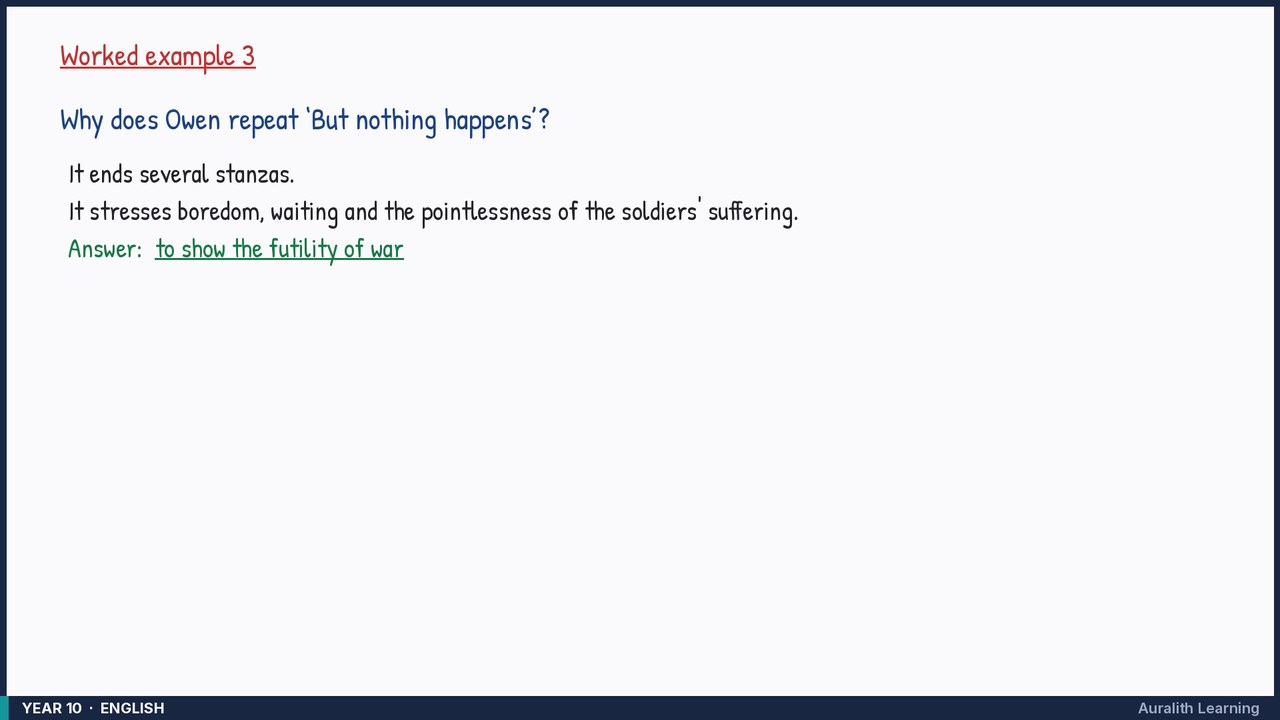
Question 3
Why does Owen repeat ‘But nothing happens’?
- Step 1: It ends several stanzas.
- Step 2: It stresses boredom, waiting and the pointlessness of the soldiers' suffering.
Answer: to show the futility of war