Year 10 (ages 14–15, Grade 9 in the US) · English · AQA poetry: Power and Conflict · Lesson 6
Comparing poems: the AQA anthology question
How to answer the AQA anthology question: compare the printed poem with one other from Power and Conflict. Choosing the second poem, planning by theme, comparative paragraphs, and how the marks are given.
Exam boards: this lesson matches the AQA GCSE English courses. Check which course your school follows.
9-minute video lesson
Teaching, worked examples and 20 practice questions solved step by step.
Watch free for a monthWhat your child will learn
- Understand the AQA anthology question
- Choose a strong second poem quickly
- Plan a comparison by theme, not poem by poem
- Write comparative paragraphs with linking words
The method
- Underline the focus in the question.
- Choose the second poem that fits the focus best.
- Plan 3 points of comparison.
- Each paragraph: both poems, linked with a connective.
- Conclude on the poets' different messages.
Key words: compare, contrast, comparative connective, theme, viewpoint.
Worked examples
Worked examples from the lesson, with every step.
Question 1
The question names ‘London’ and asks about the effects of power. Choose a second poem.
- Step 1: Powerful institutions cause suffering.
- Step 2: Checking Out Me History: those in power control what people learn.
Answer: e.g. ‘Checking Out Me History’ (or ‘My Last Duchess’)
Question 2
Why plan by theme rather than writing about one poem then the other?
- Step 1: Comparison only happens at the end, if at all.
- Step 2: Every paragraph compares, which the mark scheme rewards.
Answer: it keeps the comparison going in every paragraph
Question 3
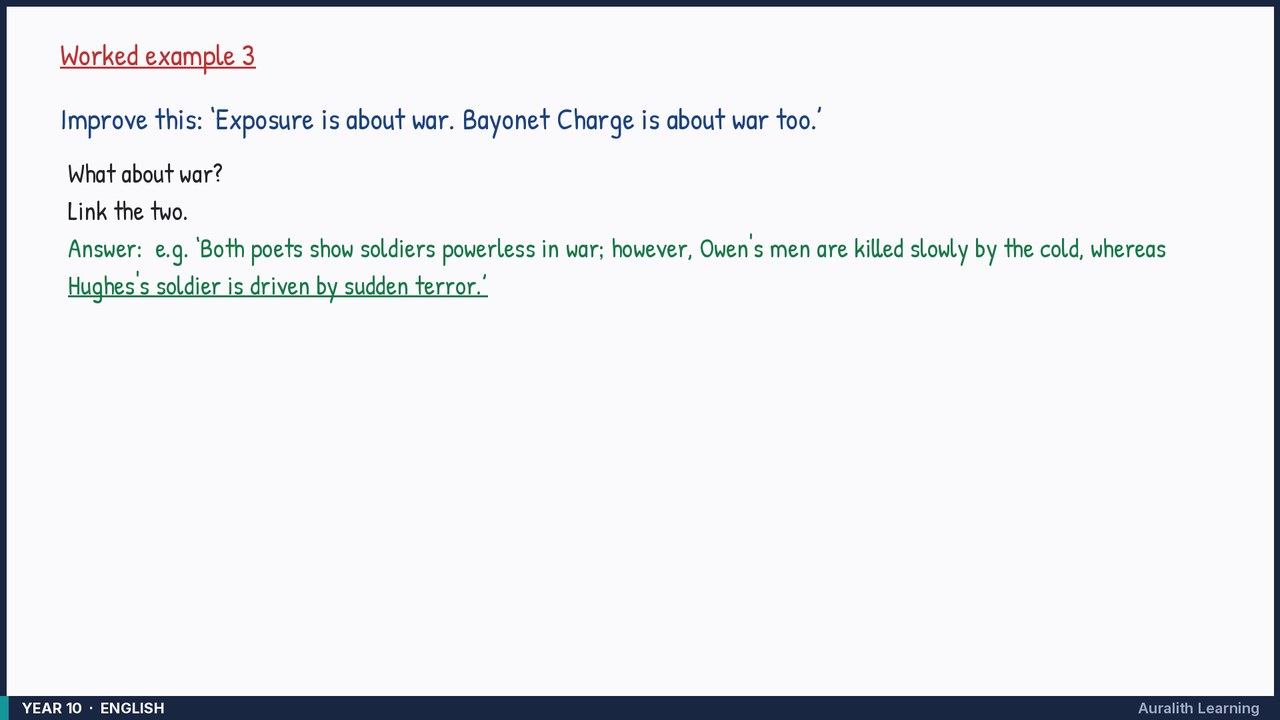
Improve this: ‘Exposure is about war. Bayonet Charge is about war too.’
- Step 1: What about war?
- Step 2: Link the two.
Answer: e.g. ‘Both poets show soldiers powerless in war; however, Owen's men are killed slowly by the cold, whereas Hughes's soldier is driven by sudden terror.’