Year 10 (ages 14–15, Grade 9 in the US) · English · AQA poetry: Power and Conflict · Lesson 1
Ozymandias and London: the power of people and places
An introduction to the AQA Power and Conflict poetry cluster, then two Romantic poems about human power: Shelley's ‘Ozymandias’, where time destroys a proud king's empire, and Blake's ‘London’, where the powerful oppress ordinary people.
Exam boards: this lesson matches the AQA GCSE English courses. Check which course your school follows.
9-minute video lesson
Teaching, worked examples and 20 practice questions solved step by step.
Watch free for a monthWhat your child will learn
- Know what the Power and Conflict cluster is and how it is examined
- Analyse how Shelley presents the limits of human power in ‘Ozymandias’
- Analyse how Blake presents the abuse of power in ‘London’
- Compare the two poems' views of power
The method
- Find the type of power in the poem.
- Pick key quotations and name the method.
- Explain the effect on the reader.
- Link to the poet's context and purpose.
- Compare: how is power shown in each?
Key words: sonnet, irony, Romantic, dramatic monologue, oppression.
Worked examples
Worked examples from the lesson, with every step.
Question 1
What does ‘sneer of cold command’ suggest about Ozymandias?
- Step 1: ‘sneer’ and ‘cold’ suggest contempt and cruelty.
- Step 2: Harsh ‘c’ sounds make him sound hard.
- Step 3: He was a proud, cruel ruler.
Answer: he was arrogant and cruel
Question 2
Why is ‘Look on my Works, ye Mighty, and despair!’ ironic?
- Step 1: He meant: despair, because you can never match me.
- Step 2: Nothing remains, so the mighty should despair that their power will fade too.
Answer: his works have vanished, so the boast now mocks him
Question 3
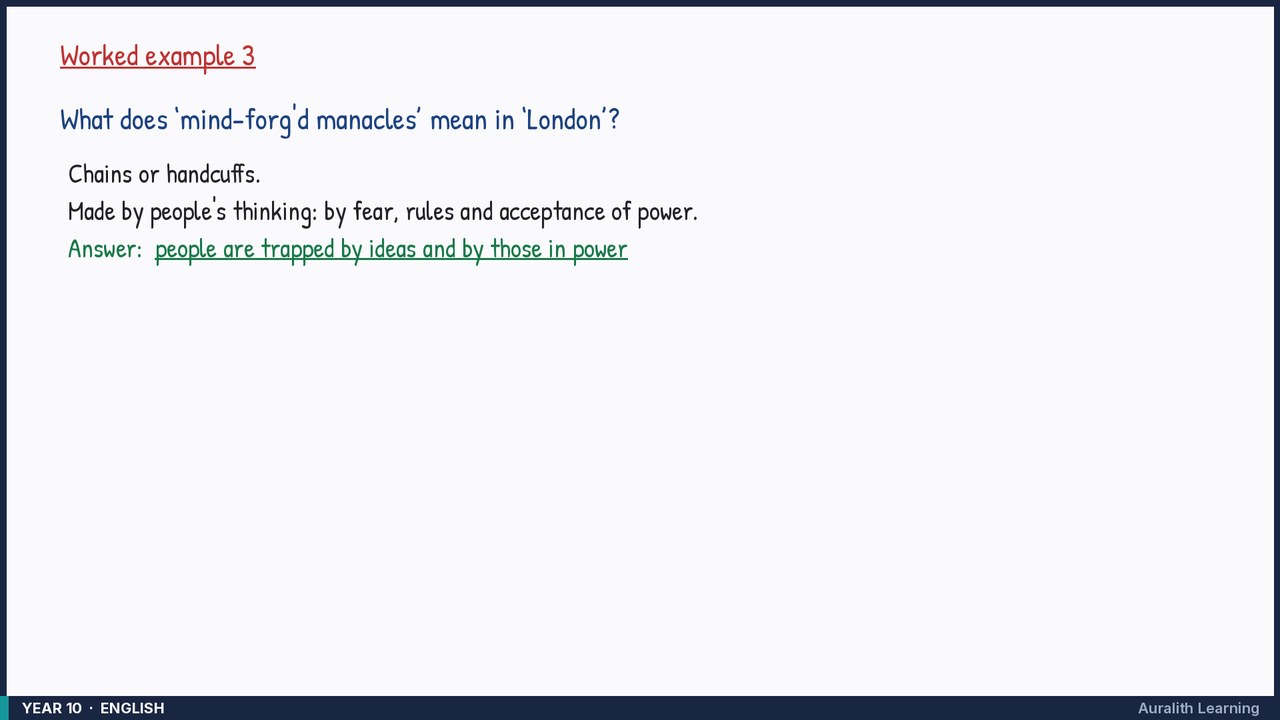
What does ‘mind-forg'd manacles’ mean in ‘London’?
- Step 1: Chains or handcuffs.
- Step 2: Made by people's thinking: by fear, rules and acceptance of power.
Answer: people are trapped by ideas and by those in power