Year 10 (ages 14–15, Grade 9 in the US) · English · AQA poetry: Power and Conflict · Lesson 5
Storm on the Island, Tissue, The Émigrée and Checking Out Me History
Four modern AQA Power and Conflict poems about the power of nature, of paper and records, of memory and of education: what happens, the poets' viewpoints and key methods, and good comparison pairs. Learn their exact quotations from your own anthology.
Exam boards: this lesson matches the AQA GCSE English courses. Check which course your school follows.
9-minute video lesson
Teaching, worked examples and 20 practice questions solved step by step.
Watch free for a monthWhat your child will learn
- Summarise four modern poems from the cluster
- Explain what kind of power each poem explores
- Identify each poet's key methods
- Choose strong comparison pairs
The method
- What kind of power is in the poem?
- Who is speaking, and what do they feel?
- Which method stands out?
- Pair it with another poem.
- Pick two short quotations from your anthology.
Key words: identity, heritage, extended metaphor, dialect, personification.
Worked examples
Worked examples from the lesson, with every step.
Question 1
What kind of power does ‘Storm on the Island’ explore?
- Step 1: The power of a storm.
- Step 2: Possibly political conflict in Northern Ireland.
Answer: the power of nature (and possibly political conflict)
Question 2
What is an extended metaphor, and where is one?
- Step 1: A metaphor developed through a whole poem.
- Step 2: In ‘Tissue’, paper stands for human life and power throughout.
Answer: a metaphor kept going through a poem, e.g. paper in ‘Tissue’
Question 3
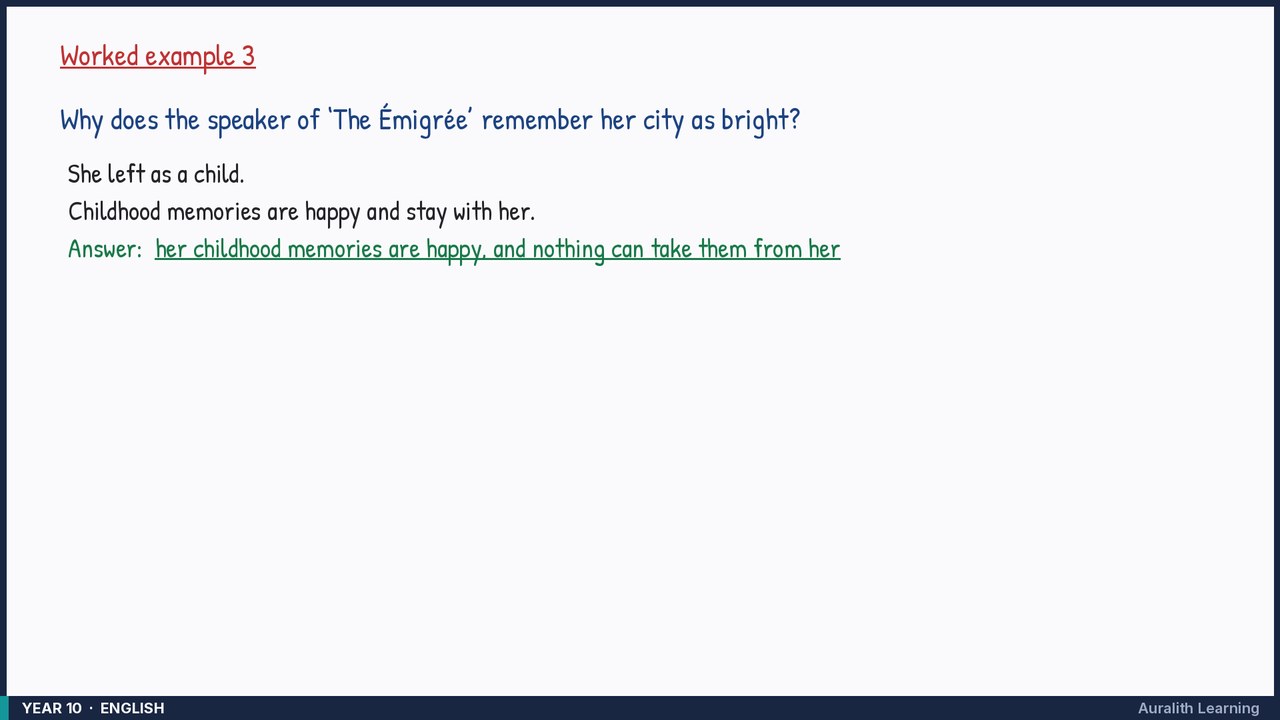
Why does the speaker of ‘The Émigrée’ remember her city as bright?
- Step 1: She left as a child.
- Step 2: Childhood memories are happy and stay with her.
Answer: her childhood memories are happy, and nothing can take them from her