Year 11 (ages 15–16, Grade 10 in the US) · Maths · Higher geometry · Lesson 3
Vectors and vector proof
Column vectors, adding, subtracting and multiplying vectors by a scalar, finding the magnitude of a vector, writing paths between points in terms of given vectors, and using vectors to prove that lines are parallel or points are collinear.
Exam boards: this lesson matches the AQA and Pearson Edexcel GCSE maths courses. Check which course your school follows.
9-minute video lesson
Teaching, worked examples and 20 practice questions solved step by step.
Watch free for a monthWhat your child will learn
- Add, subtract and scale column vectors
- Find the magnitude of a vector
- Write vector paths in terms of a and b
- Prove lines are parallel or points collinear
The method
- A vector has size and direction.
- Find a path from start to end using known vectors.
- Going backwards along a vector makes it negative.
- Parallel vectors are multiples of each other.
Key words: vector, scalar, magnitude, parallel, collinear.
Worked examples
Worked examples from the lesson, with every step.
Question 1
a = (2, 5) and b = (−1, 3). Find a + b and 3a − b.
- Step 1: (2 + −1, 5 + 3) = (1, 8)
- Step 2: 3a = (6, 15)
- Step 3: (6 − −1, 15 − 3) = (7, 12)
Answer: a + b = (1, 8); 3a − b = (7, 12)
Question 2
Find the magnitude of the vector (5, −12).
- Step 1: √(5² + (−12)²)
- Step 2: √(25 + 144) = √169
Answer: 13
Question 3
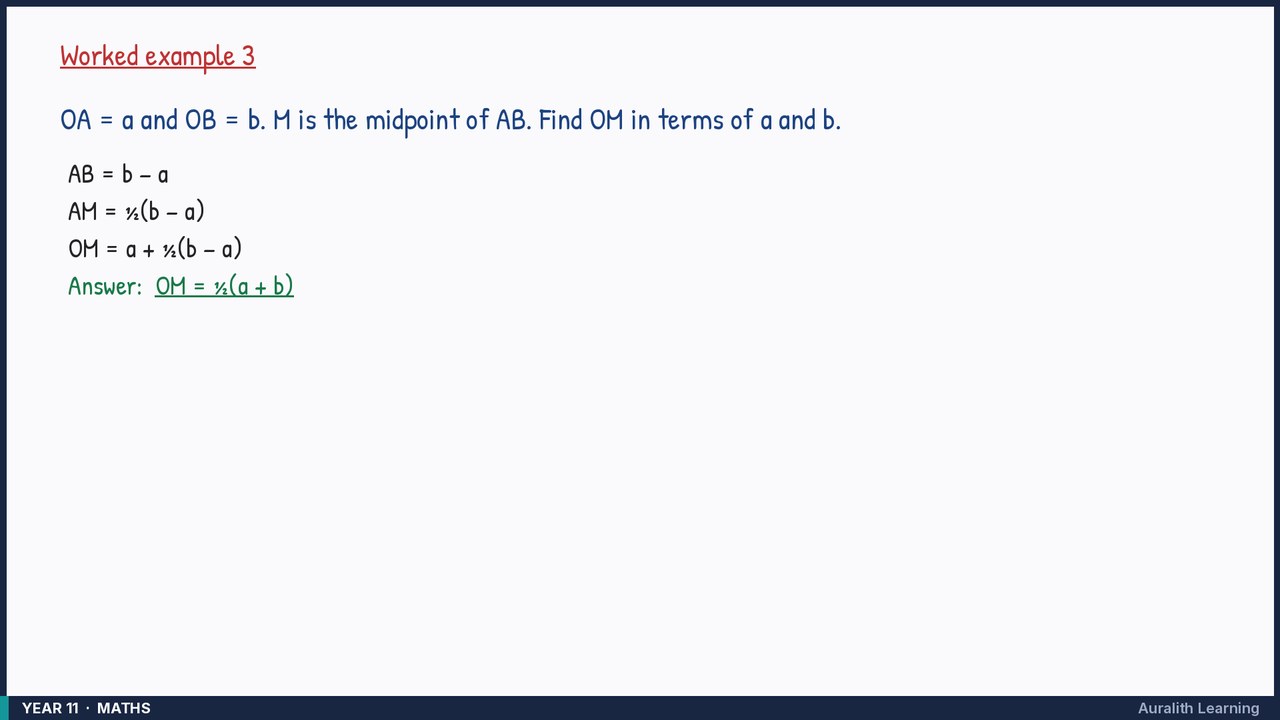
OA = a and OB = b. M is the midpoint of AB. Find OM in terms of a and b.
- Step 1: AB = b − a
- Step 2: AM = ½(b − a)
- Step 3: OM = a + ½(b − a)
Answer: OM = ½(a + b)