Year 11 (ages 15–16, Grade 10 in the US) · Maths · Higher geometry · Lesson 2
The sine rule, the cosine rule and area of a triangle
Using the sine rule and the cosine rule to find missing sides and angles in triangles that are not right-angled, choosing the correct rule, and finding the area of a triangle using ½ab sin C.
Exam boards: this lesson matches the AQA and Pearson Edexcel GCSE maths courses. Check which course your school follows.
12-minute video lesson
Teaching, worked examples and 20 practice questions solved step by step.
Watch free for a monthWhat your child will learn
- Use the sine rule to find sides and angles
- Use the cosine rule to find sides and angles
- Choose the correct rule
- Find the area of any triangle using ½ab sin C
The method
- Label sides a, b, c opposite angles A, B, C.
- Two angles and a side, or a side–angle pair: sine rule.
- Two sides and the included angle, or three sides: cosine rule.
- Area = ½ab sin C.
Key words: sine rule, cosine rule, included angle, opposite side, area.
Worked examples
Worked examples from the lesson, with every step.
Question 1
In triangle ABC, A = 40°, B = 65° and a = 8 cm. Find b to 1 decimal place.
- Step 1: Sine rule: b/sin B = a/sin A
- Step 2: b = 8 sin 65° ÷ sin 40°
- Step 3: = 11.279…
Answer: b = 11.3 cm
Question 2
In triangle ABC, b = 7 cm, c = 9 cm and A = 50°. Find a to 1 decimal place.
- Step 1: Cosine rule: a² = b² + c² − 2bc cos A
- Step 2: a² = 49 + 81 − 2 × 7 × 9 × cos 50°
- Step 3: a² = 49.008… → a = 7.0006…
Answer: a = 7.0 cm
Question 3
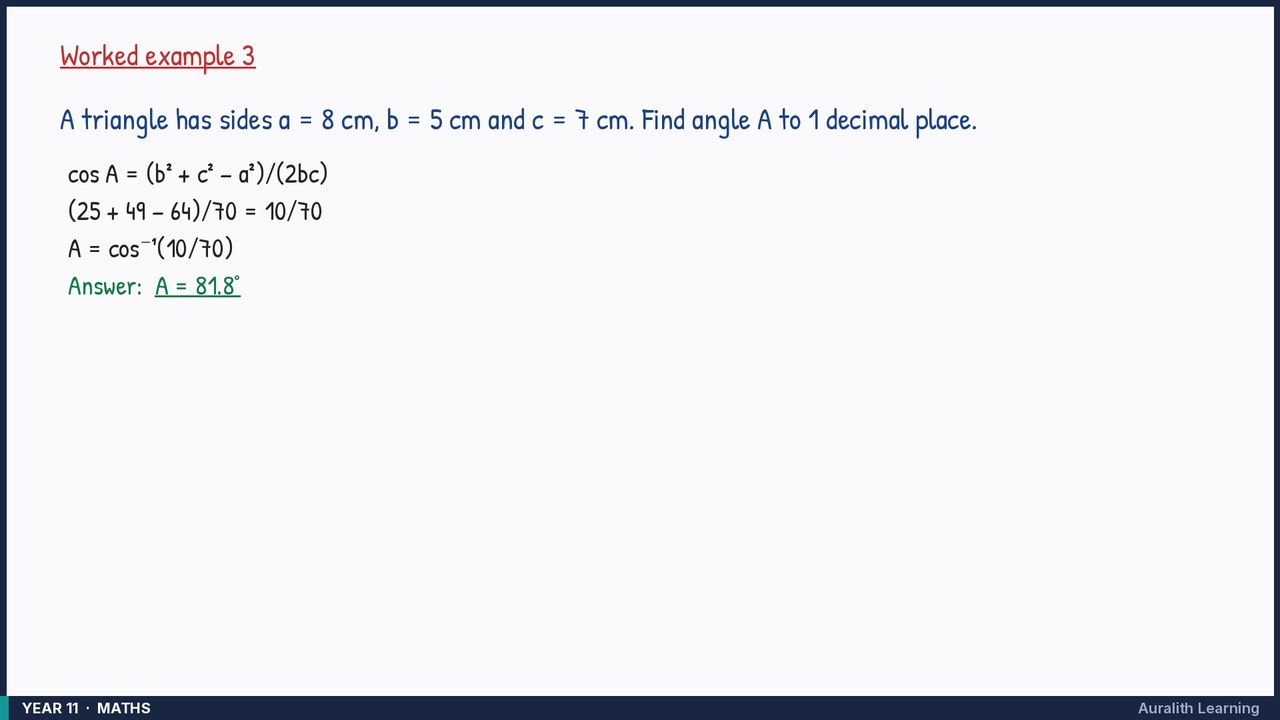
A triangle has sides a = 8 cm, b = 5 cm and c = 7 cm. Find angle A to 1 decimal place.
- Step 1: cos A = (b² + c² − a²)/(2bc)
- Step 2: (25 + 49 − 64)/70 = 10/70
- Step 3: A = cos⁻¹(10/70)
Answer: A = 81.8°