Year 11 (ages 15–16, Grade 10 in the US) · Maths · Higher geometry · Lesson 1
Circle theorems
The main circle theorems: angles at the centre and circumference, angles in a semicircle and the same segment, cyclic quadrilaterals, tangents and radii, chords, and the alternate segment theorem, with clear reasons in proofs.
Exam boards: this lesson matches the AQA and Pearson Edexcel GCSE maths courses. Check which course your school follows.
10-minute video lesson
Teaching, worked examples and 20 practice questions solved step by step.
Watch free for a monthWhat your child will learn
- Recall the main circle theorems
- Use circle theorems to find missing angles
- Give reasons using correct wording
- Combine circle theorems with other angle facts
The method
- Mark what you know on a sketch.
- Look for radii (isosceles triangles), tangents and cyclic quadrilaterals.
- Use one fact at a time.
- State the theorem as your reason.
Key words: circumference, cyclic quadrilateral, tangent, chord, segment.
Worked examples
Worked examples from the lesson, with every step.
Question 1
Points A, B and C lie on a circle with centre O. Angle ACB = 35°. Find angle AOB.
- Step 1: Angle at centre = 2 × angle at circumference
- Step 2: 2 × 35° = 70°
Answer: 70°
Question 2
ABCD is a cyclic quadrilateral. Angle ABC = 110°. Find angle ADC.
- Step 1: Opposite angles add to 180°
- Step 2: 180° − 110° = 70°
Answer: 70°
Question 3
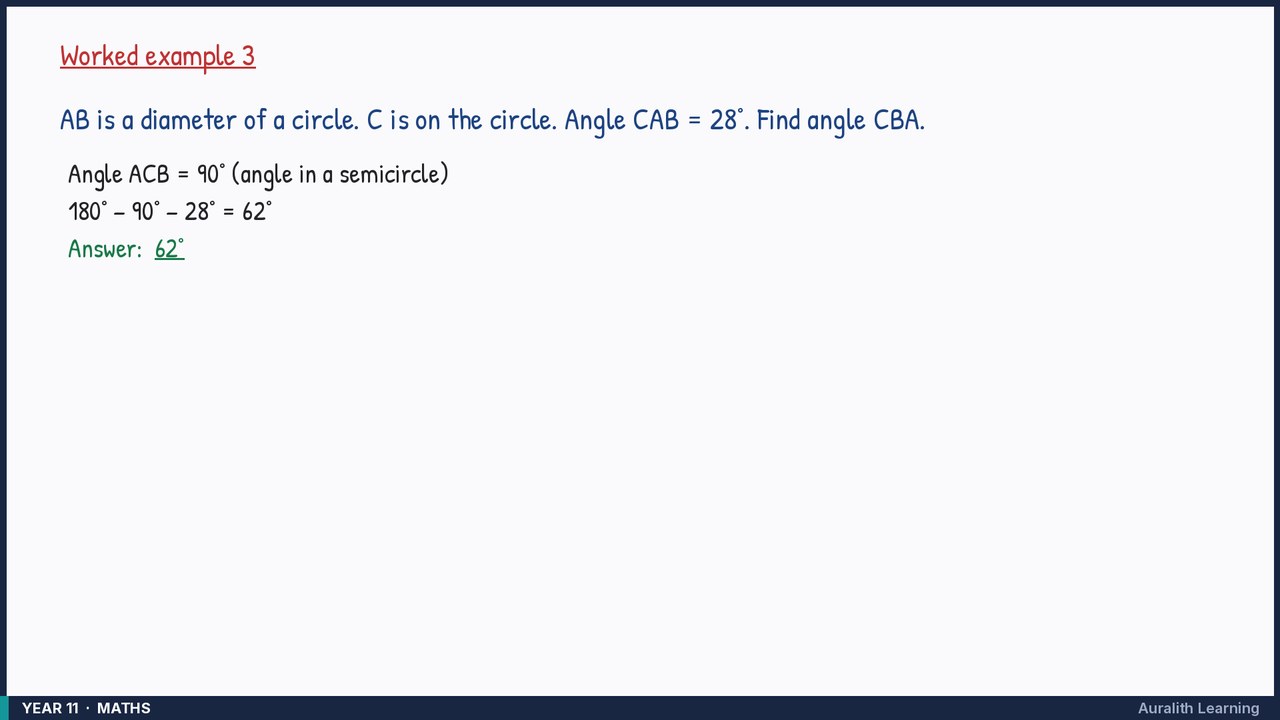
AB is a diameter of a circle. C is on the circle. Angle CAB = 28°. Find angle CBA.
- Step 1: Angle ACB = 90° (angle in a semicircle)
- Step 2: 180° − 90° − 28° = 62°
Answer: 62°