Year 11 (ages 15–16, Grade 10 in the US) · Maths · Higher geometry · Lesson 4
Spheres, cones and frustums
Volume and surface area of spheres, hemispheres and cones, finding the slant height of a cone with Pythagoras, the volume of a frustum, and answers in terms of π.
Exam boards: this lesson matches the AQA and Pearson Edexcel GCSE maths courses. Check which course your school follows.
11-minute video lesson
Teaching, worked examples and 20 practice questions solved step by step.
Watch free for a monthWhat your child will learn
- Find the volume and surface area of a sphere
- Find the volume and surface area of a cone
- Use Pythagoras to find a slant height
- Find the volume of a frustum
The method
- Sphere: V = ⁴⁄₃πr³, surface area = 4πr².
- Cone: V = ⅓πr²h, curved surface area = πrl.
- Slant height: l² = r² + h².
- Frustum = big cone − small cone.
Key words: sphere, hemisphere, cone, slant height, frustum.
Worked examples
Worked examples from the lesson, with every step.
Question 1
Find the volume of a sphere of radius 5 cm, to 1 decimal place.
- Step 1: V = ⁴⁄₃πr³
- Step 2: ⁴⁄₃ × π × 125
Answer: 523.6 cm³
Question 2
A cone has radius 6 cm and height 8 cm. Find its total surface area in terms of π.
- Step 1: l = √(36 + 64) = 10
- Step 2: π × 6 × 10 = 60π
- Step 3: π × 6² = 36π
Answer: 96π cm²
Question 3
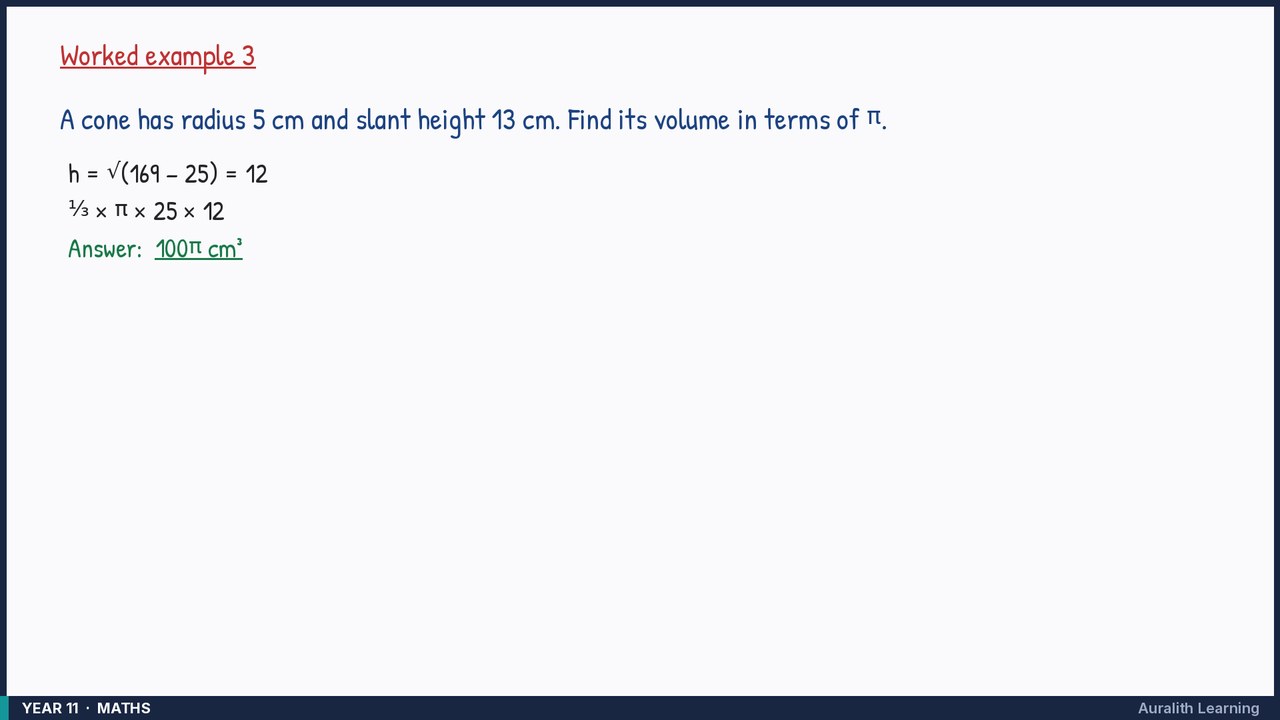
A cone has radius 5 cm and slant height 13 cm. Find its volume in terms of π.
- Step 1: h = √(169 − 25) = 12
- Step 2: ⅓ × π × 25 × 12
Answer: 100π cm³