Year 11 (ages 15–16, Grade 10 in the US) · History · Germany 1890–1918: the Kaiser's Germany · Lesson 3
Weltpolitik and the Navy Laws
The Kaiser's ‘world policy’ (Weltpolitik) to make Germany a great power, Admiral Tirpitz's Navy Laws of 1898 and 1900, the naval race with Britain, and why building a navy also mattered inside Germany: uniting people behind the Kaiser and against socialism.
Exam boards: this lesson matches the AQA GCSE history courses. Check which course your school follows.
9-minute video lesson
Teaching, worked examples and 20 practice questions solved step by step.
Watch free for a monthWhat your child will learn
- Explain what Weltpolitik was
- Describe the Navy Laws and the naval race
- Explain the domestic importance of the Navy Laws
- Assess the costs and consequences
The method
- What did the Kaiser want for Germany?
- What did the Navy Laws do?
- How did Britain react?
- Who supported the navy inside Germany, and why?
- What problems did it cause?
Key words: Weltpolitik, Navy Laws, naval race, Dreadnought, nationalism.
Worked examples
Worked examples from the lesson, with every step.
Question 1
Describe two features of Weltpolitik. (4 marks)
- Step 1: It aimed to make Germany a world power with colonies.
- Step 2: It depended on building a large navy.
Answer: aiming for world power and colonies; building a large navy
Question 2
What did the Navy Laws of 1898 and 1900 do?
- Step 1: They approved the building of a large fleet of battleships, planned by Tirpitz.
Answer: approved a big expansion of the German battle fleet
Question 3
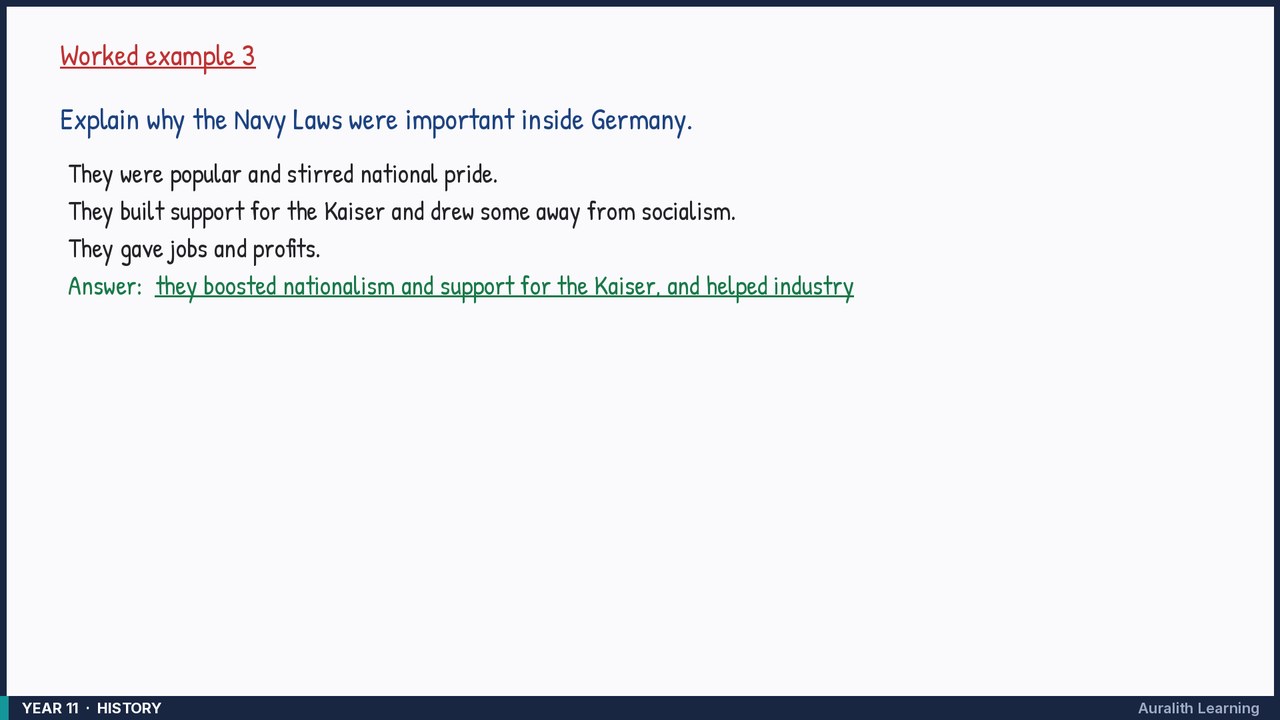
Explain why the Navy Laws were important inside Germany.
- Step 1: They were popular and stirred national pride.
- Step 2: They built support for the Kaiser and drew some away from socialism.
- Step 3: They gave jobs and profits.
Answer: they boosted nationalism and support for the Kaiser, and helped industry