Year 11 (ages 15–16, Grade 10 in the US) · History · Germany 1890–1918: the Kaiser's Germany · Lesson 1
Kaiser Wilhelm II and the difficulties of ruling Germany
Who Kaiser Wilhelm II was, how the German Empire was governed under its 1871 constitution, how much power the Reichstag really had, and why Prussian militarism shaped the country, making Germany hard to rule by the 1890s.
Exam boards: this lesson matches the AQA GCSE history courses. Check which course your school follows.
9-minute video lesson
Teaching, worked examples and 20 practice questions solved step by step.
Watch free for a monthWhat your child will learn
- Describe Kaiser Wilhelm II's background and character
- Explain how the German constitution divided power
- Explain the influence of Prussia and the army
- Assess why Germany was difficult to rule
The method
- Who held power: the Kaiser, the Chancellor, or the Reichstag?
- What could each one do?
- How did Prussia and the army influence decisions?
- What problems did this cause?
- Make a judgement: how powerful was the Kaiser?
Key words: Kaiser, Reichstag, Bundesrat, Chancellor, militarism.
Worked examples
Worked examples from the lesson, with every step.
Question 1
Describe two features of the Reichstag's power before 1914. (4 marks)
- Step 1: It was elected by men over 25, so it gave the people a voice.
- Step 2: It voted on laws and the budget, but could not appoint or remove the Chancellor.
Answer: elected by men over 25; voted on laws and budget but could not control the Chancellor
Question 2
Why was Bismarck's dismissal in 1890 important?
- Step 1: The Kaiser removed his most experienced minister.
- Step 2: Wilhelm took a more personal, less predictable role in government.
Answer: it allowed the Kaiser to rule more personally and impulsively
Question 3
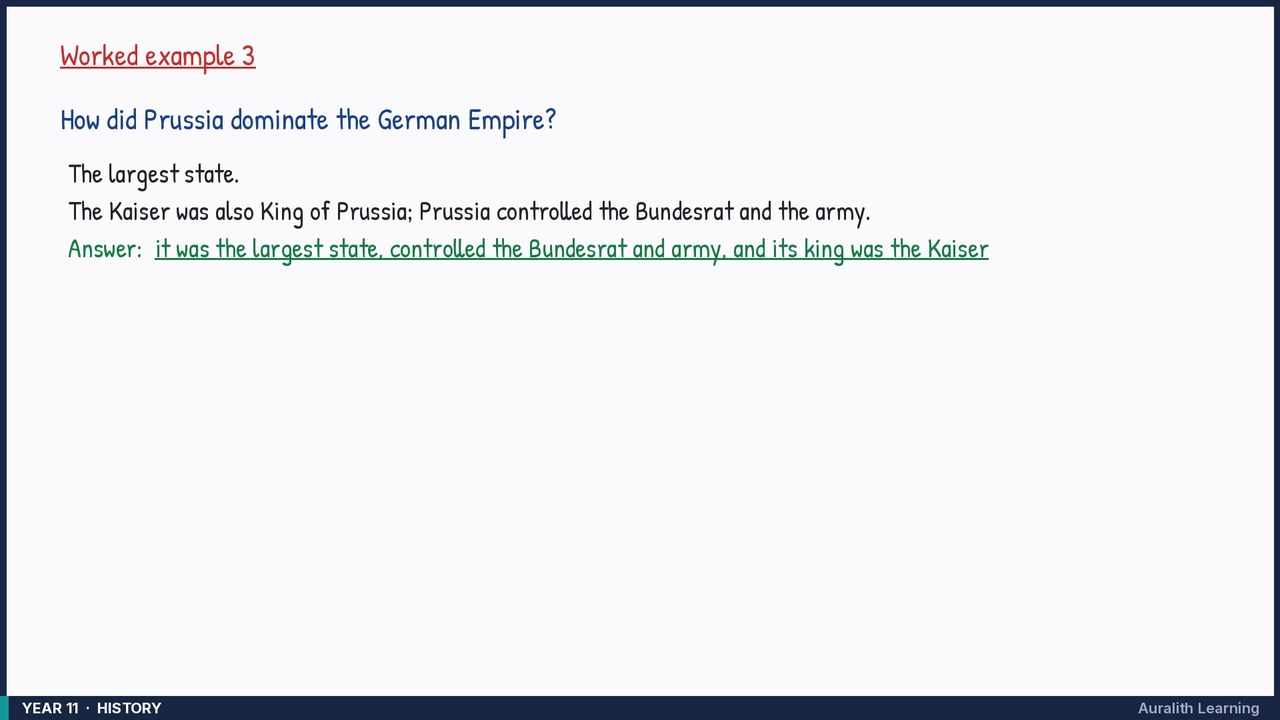
How did Prussia dominate the German Empire?
- Step 1: The largest state.
- Step 2: The Kaiser was also King of Prussia; Prussia controlled the Bundesrat and the army.
Answer: it was the largest state, controlled the Bundesrat and army, and its king was the Kaiser