Year 11 (ages 15–16, Grade 10 in the US) · History · Germany 1890–1918: the Kaiser's Germany · Lesson 2
Industrialisation, social reform and the growth of socialism
How Germany's rapid industrial growth after 1890 created a large working class, how governments responded with social reforms, and why the socialist SPD grew to become the largest party in the Reichstag by 1912, worrying the Kaiser and the elite.
Exam boards: this lesson matches the AQA GCSE history courses. Check which course your school follows.
9-minute video lesson
Teaching, worked examples and 20 practice questions solved step by step.
Watch free for a monthWhat your child will learn
- Describe Germany's industrial growth before 1914
- Explain the effects of industrialisation on society
- Describe social reforms and their aims
- Explain why the growth of socialism worried the Kaiser
The method
- What changed in Germany's economy?
- Who gained and who struggled?
- How did the government respond?
- Why did the SPD grow?
- Why did this alarm the Kaiser?
Key words: industrialisation, working class, socialism, SPD, trade union.
Worked examples
Worked examples from the lesson, with every step.
Question 1
Describe two effects of industrialisation on German society. (4 marks)
- Step 1: A large working class grew in crowded cities.
- Step 2: Trade unions and the SPD grew, demanding change.
Answer: a large urban working class; growth of trade unions and socialism
Question 2
Why did governments introduce social reforms?
- Step 1: Workers were attracted to socialism.
- Step 2: Improve conditions so workers stayed loyal to the empire.
Answer: to reduce support for socialism by improving workers' lives
Question 3
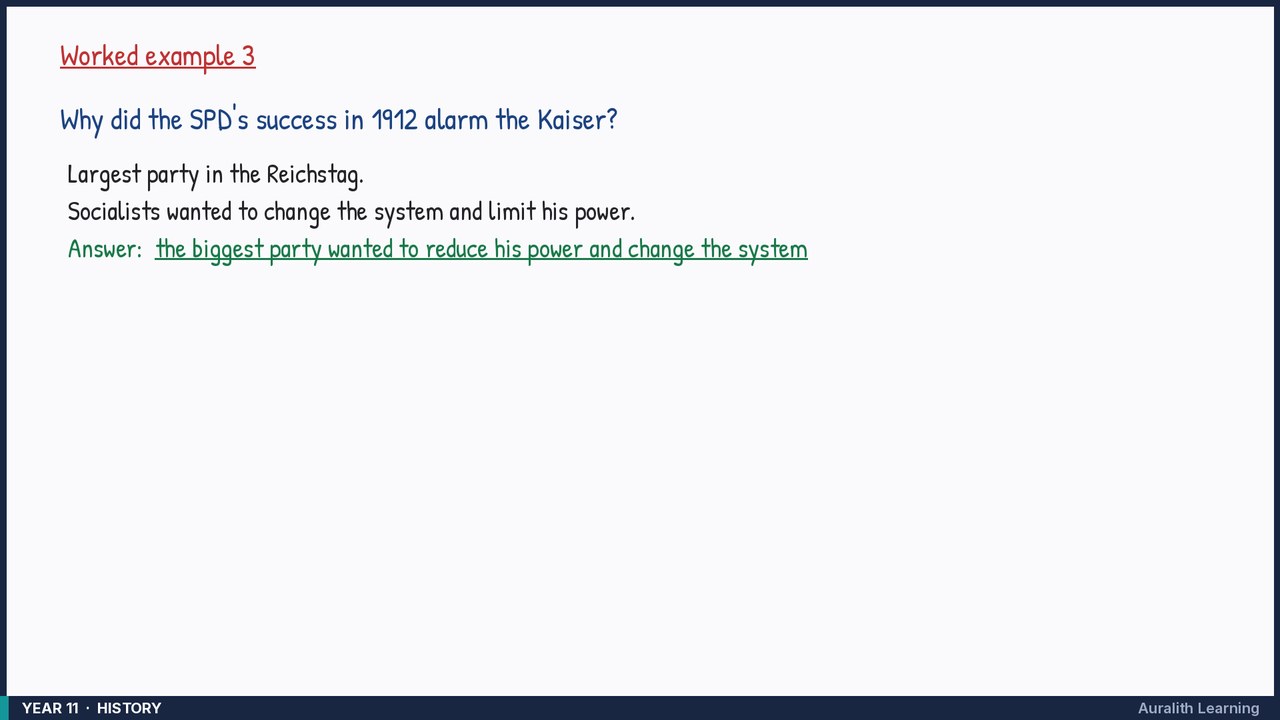
Why did the SPD's success in 1912 alarm the Kaiser?
- Step 1: Largest party in the Reichstag.
- Step 2: Socialists wanted to change the system and limit his power.
Answer: the biggest party wanted to reduce his power and change the system