Year 11 (ages 15–16, Grade 10 in the US) · History · Germany 1890–1918: the Kaiser's Germany · Lesson 4
The First World War and the end of the monarchy, 1914–18
How the First World War affected Germany: early unity, then food shortages from the British naval blockade, the ‘turnip winter’ of 1916–17, war weariness and strikes, military defeat in 1918, the sailors' mutiny and revolution, and the Kaiser's abdication on 9 November 1918.
Exam boards: this lesson matches the AQA GCSE history courses. Check which course your school follows.
9-minute video lesson
Teaching, worked examples and 20 practice questions solved step by step.
Watch free for a monthWhat your child will learn
- Describe the effects of the war on German civilians
- Explain why war weariness grew
- Describe the events of October–November 1918
- Explain why the Kaiser abdicated
The method
- How did Germans feel in 1914?
- What went wrong at home?
- What happened in the war in 1918?
- How did revolution start?
- Why did the Kaiser go?
Key words: blockade, war weariness, mutiny, abdication, armistice.
Worked examples
Worked examples from the lesson, with every step.
Question 1
Describe two effects of the British naval blockade on Germany. (4 marks)
- Step 1: Severe food shortages, e.g. the ‘turnip winter’ of 1916–17.
- Step 2: Hunger and disease killed hundreds of thousands, and caused strikes.
Answer: food shortages such as the turnip winter; deaths, protests and strikes
Question 2
What was war weariness?
- Step 1: Exhaustion and anger after years of war and hardship.
- Step 2: Strikes, protests and falling morale.
Answer: growing exhaustion and discontent with the war
Question 3
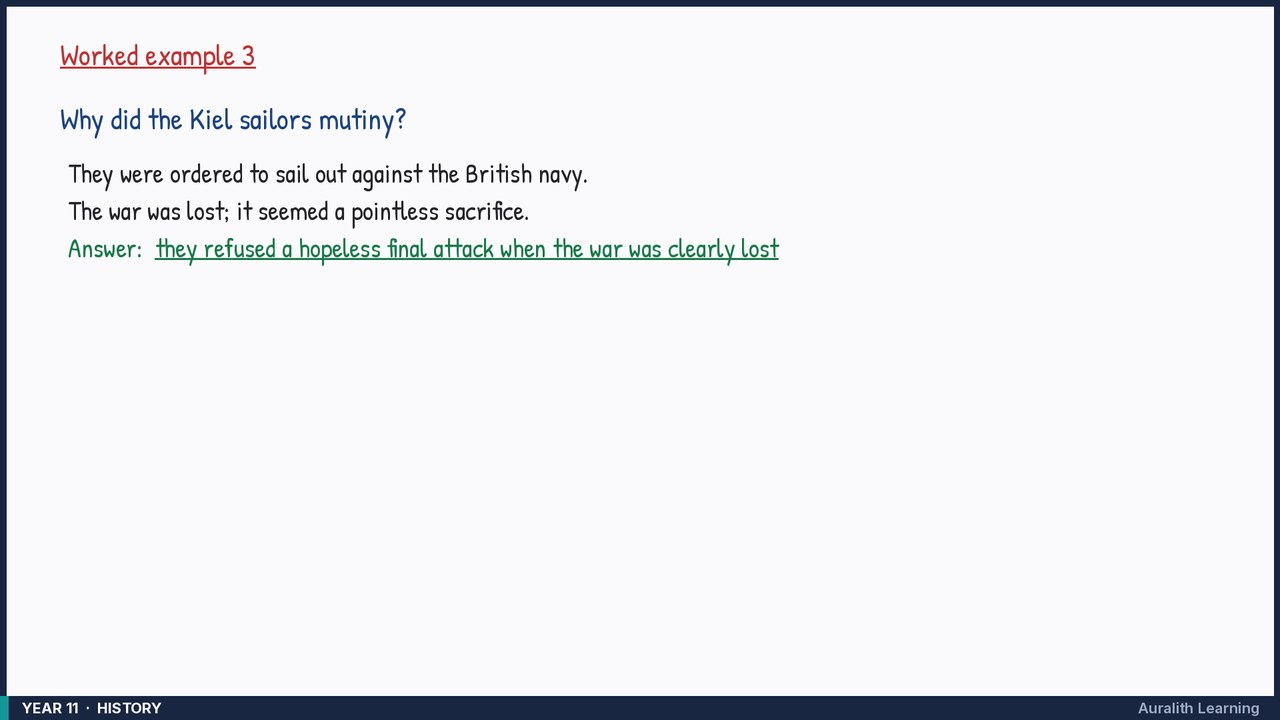
Why did the Kiel sailors mutiny?
- Step 1: They were ordered to sail out against the British navy.
- Step 2: The war was lost; it seemed a pointless sacrifice.
Answer: they refused a hopeless final attack when the war was clearly lost