Year 11 (ages 15–16, Grade 10 in the US) · History · GCSE British depth study · Lesson 3
Mary, Queen of Scots and the Catholic plots
Why Mary, Queen of Scots was a threat to Elizabeth I, the Revolt of the Northern Earls, the Ridolfi, Throckmorton and Babington plots, Walsingham's spy network, and Mary's execution in 1587.
Exam boards: this lesson matches the AQA and Pearson Edexcel GCSE history courses. Check which course your school follows.
9-minute video lesson
Teaching, worked examples and 20 practice questions solved step by step.
Watch free for a monthWhat your child will learn
- Explain why Mary, Queen of Scots was a threat
- Describe the Revolt of the Northern Earls
- Describe the main Catholic plots
- Explain why Mary was executed
The method
- Mary fled to England in 1568 and was kept under house arrest.
- 1569: Revolt of the Northern Earls.
- Plots: Ridolfi (1571), Throckmorton (1583), Babington (1586).
- Mary was executed in February 1587.
Key words: plot, Revolt of the Northern Earls, Walsingham, execution, threat.
Worked examples
Worked examples from the lesson, with every step.
Question 1
Explain why Mary, Queen of Scots was a threat to Elizabeth.
- Step 1: She had a strong claim to the throne.
- Step 2: She was Catholic, so Catholics might support her.
Answer: a Catholic with a strong claim to the throne
Question 2
What happened in the Revolt of the Northern Earls?
- Step 1: Northern Catholic earls rose up in 1569.
- Step 2: The revolt failed; many rebels were executed.
Answer: a failed northern Catholic rebellion
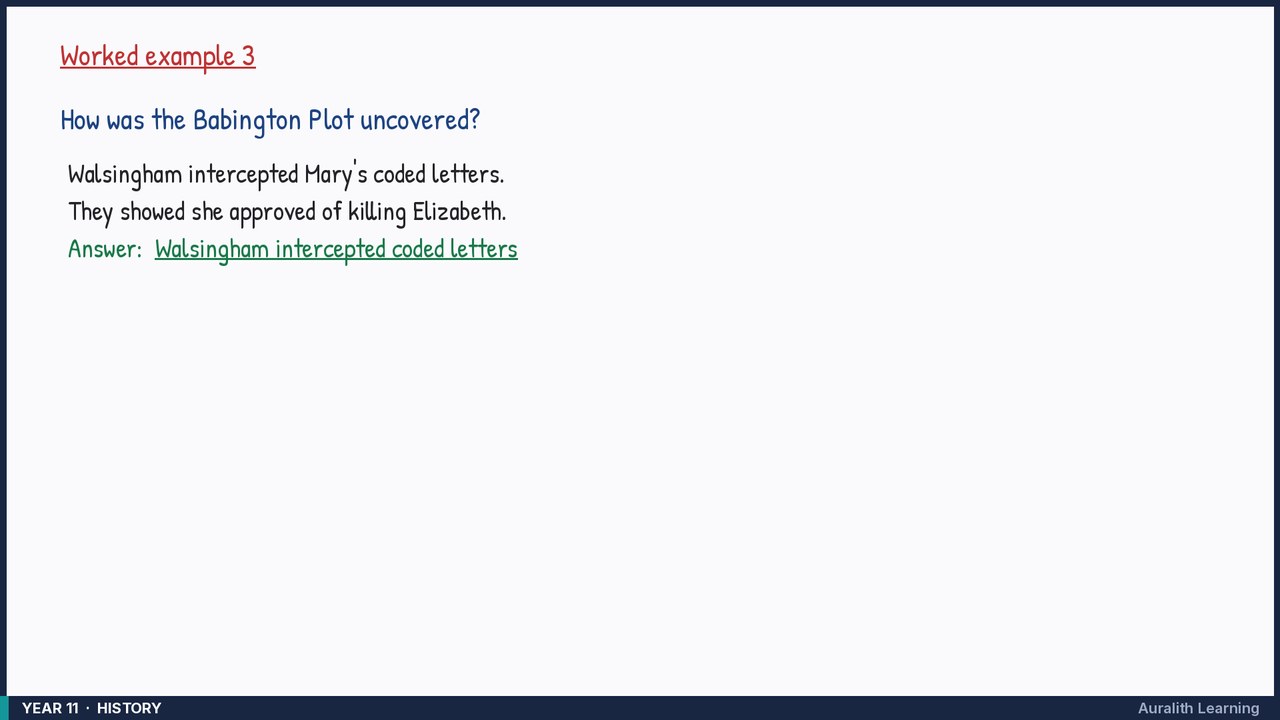
Question 3
How was the Babington Plot uncovered?
- Step 1: Walsingham intercepted Mary's coded letters.
- Step 2: They showed she approved of killing Elizabeth.
Answer: Walsingham intercepted coded letters