Year 11 (ages 15–16, Grade 10 in the US) · History · GCSE British depth study · Lesson 1
Elizabeth I: her accession and government
The situation Elizabeth I faced when she became queen in 1558 — questions over legitimacy, gender, marriage, money and foreign threats — and how Elizabethan government worked through the court, the Privy Council, Parliament and local officials.
Exam boards: this lesson matches the Pearson Edexcel GCSE history courses. Check which course your school follows.
8-minute video lesson
Teaching, worked examples and 20 practice questions solved step by step.
Watch free for a monthWhat your child will learn
- Describe the problems Elizabeth I faced in 1558
- Explain the issue of legitimacy
- Describe how Elizabethan government worked
- Explain why marriage was a key question
The method
- Elizabeth became queen in November 1558, aged 25.
- Challenges: legitimacy, gender, marriage, finance, France and Scotland.
- Government: court, Privy Council, Parliament, JPs.
- The monarch held real power; Parliament's role was limited.
Key words: legitimacy, Privy Council, Parliament, Justice of the Peace, succession.
Worked examples
Worked examples from the lesson, with every step.
Question 1
Why did some Catholics see Elizabeth I as illegitimate?
- Step 1: They didn't recognise Henry VIII's divorce from Catherine of Aragon.
- Step 2: So they saw his marriage to Anne Boleyn as invalid.
Answer: they did not accept her parents' marriage
Question 2
Give two financial problems Elizabeth faced in 1558.
- Step 1: The Crown was in debt.
- Step 2: War with France had been costly.
Answer: Crown debt; costs of war with France
Question 3
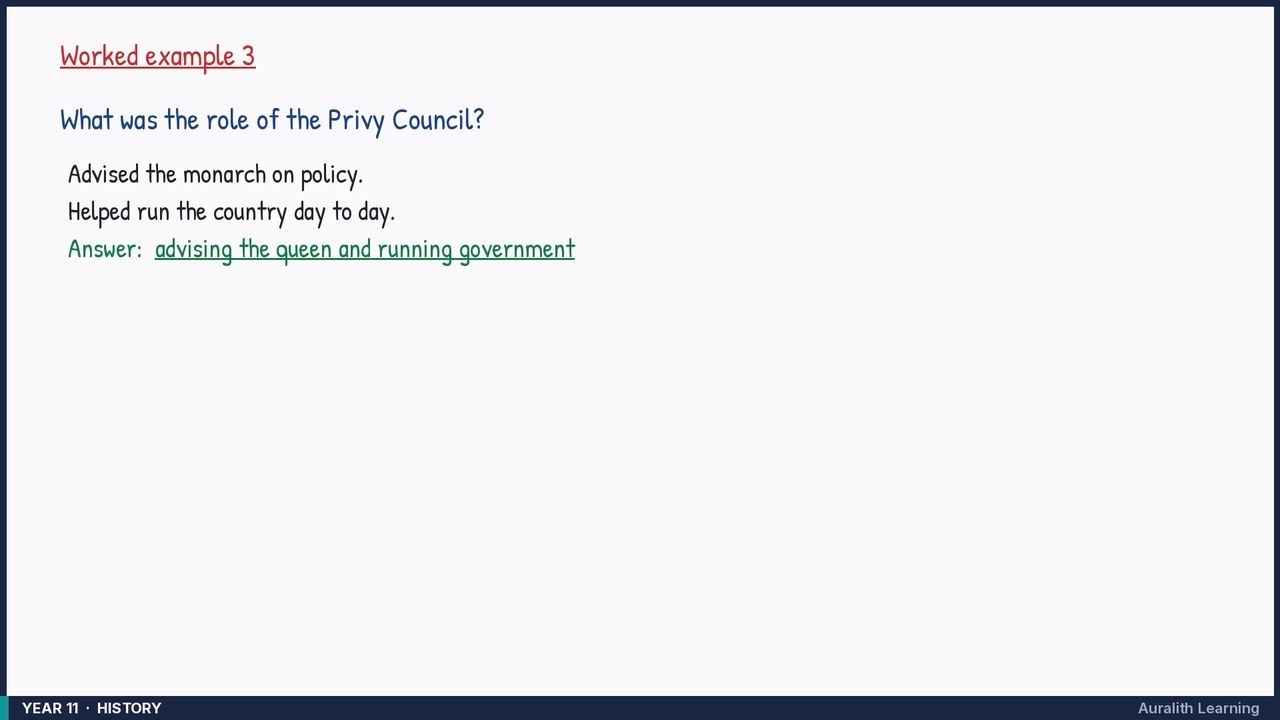
What was the role of the Privy Council?
- Step 1: Advised the monarch on policy.
- Step 2: Helped run the country day to day.
Answer: advising the queen and running government