Year 11 (ages 15–16, Grade 10 in the US) · History · GCSE British depth study · Lesson 2
The religious settlement of 1559 and its challenges
Elizabeth I's religious settlement of 1559 — the Act of Supremacy, the Act of Uniformity and the Royal Injunctions — why it was described as a ‘middle way’, and the challenges it faced from Catholics and Puritans.
Exam boards: this lesson matches the Pearson Edexcel GCSE history courses. Check which course your school follows.
8-minute video lesson
Teaching, worked examples and 20 practice questions solved step by step.
Watch free for a monthWhat your child will learn
- Describe the religious settlement of 1559
- Explain why it was a compromise
- Explain the Puritan challenge
- Explain the Catholic challenge
The method
- Act of Supremacy: Elizabeth became Supreme Governor of the Church.
- Act of Uniformity: one Book of Common Prayer for all churches.
- Royal Injunctions: instructions to clergy.
- Challenged by Catholics at home and abroad, and by Puritans.
Key words: religious settlement, Supreme Governor, Act of Uniformity, Puritan, recusant.
Worked examples
Worked examples from the lesson, with every step.
Question 1
What did the Act of Supremacy do?
- Step 1: Made Elizabeth Supreme Governor of the Church.
- Step 2: Clergy and officials had to swear an oath accepting this.
Answer: made Elizabeth Supreme Governor of the Church
Question 2
Why is the settlement called a ‘middle way’?
- Step 1: English services, married clergy.
- Step 2: Bishops, some vestments and ornaments.
Answer: it mixed Protestant and Catholic features
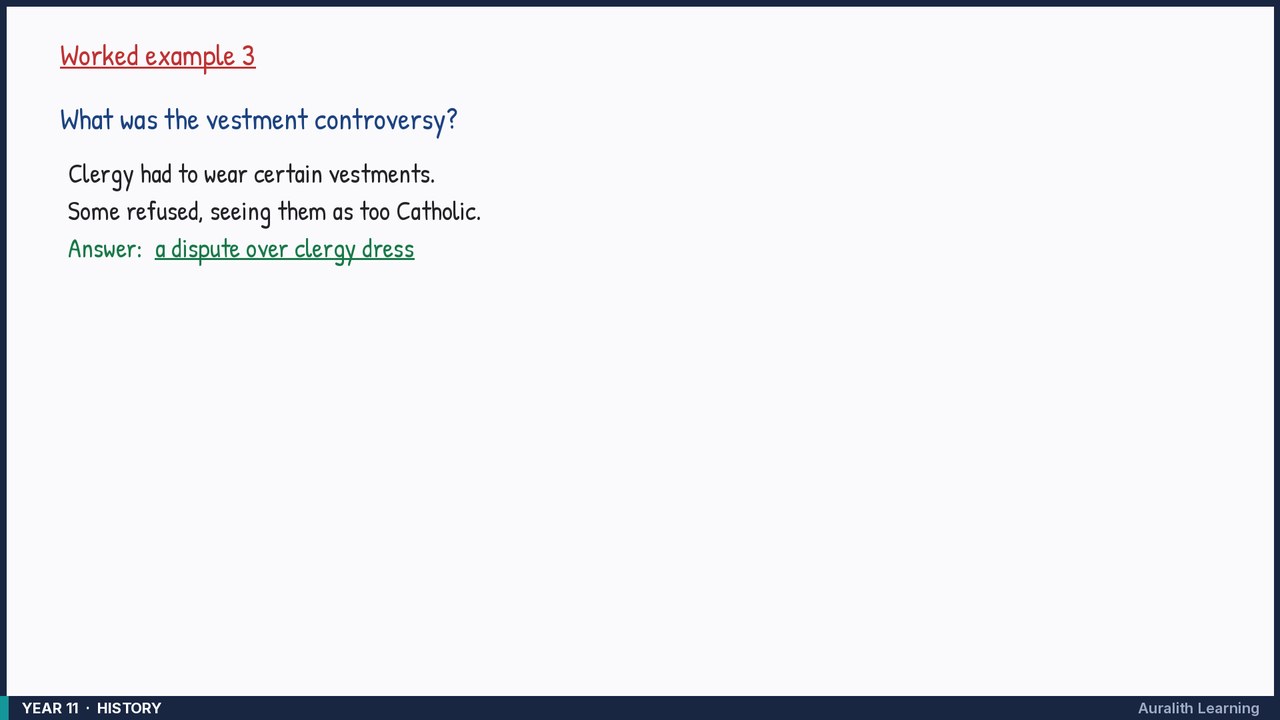
Question 3
What was the vestment controversy?
- Step 1: Clergy had to wear certain vestments.
- Step 2: Some refused, seeing them as too Catholic.
Answer: a dispute over clergy dress