Year 10 (ages 14–15, Grade 9 in the US) · Science · Chemistry: atomic structure and the periodic table · Lesson 3
Mendeleev and the periodic table
How Mendeleev arranged the elements, why he left gaps and swapped some elements, how isotopes explain those swaps, and how the modern periodic table is organised into groups and periods with metals and non-metals.
Exam boards: this lesson matches the AQA and Pearson Edexcel GCSE science courses. Check which course your school follows.
8-minute video lesson
Teaching, worked examples and 20 practice questions solved step by step.
Watch free for a monthWhat your child will learn
- Describe how Mendeleev arranged elements
- Explain his gaps and predictions
- Explain why the modern table uses atomic number
- Locate metals and non-metals
The method
- Mendeleev: order by atomic mass, group by properties.
- He left gaps for undiscovered elements.
- Modern table: order by atomic number.
- Metals on the left; non-metals on the right.
Key words: Mendeleev, group, period, atomic number, metal.
Worked examples
Worked examples from the lesson, with every step.
Question 1
How did Mendeleev order the elements?
- Step 1: By atomic mass.
- Step 2: Similar properties in columns.
Answer: by atomic mass, grouping similar properties
Question 2
Why did Mendeleev leave gaps?
- Step 1: No known element fitted.
- Step 2: He predicted new elements would fill them.
Answer: for elements not yet discovered
Question 3
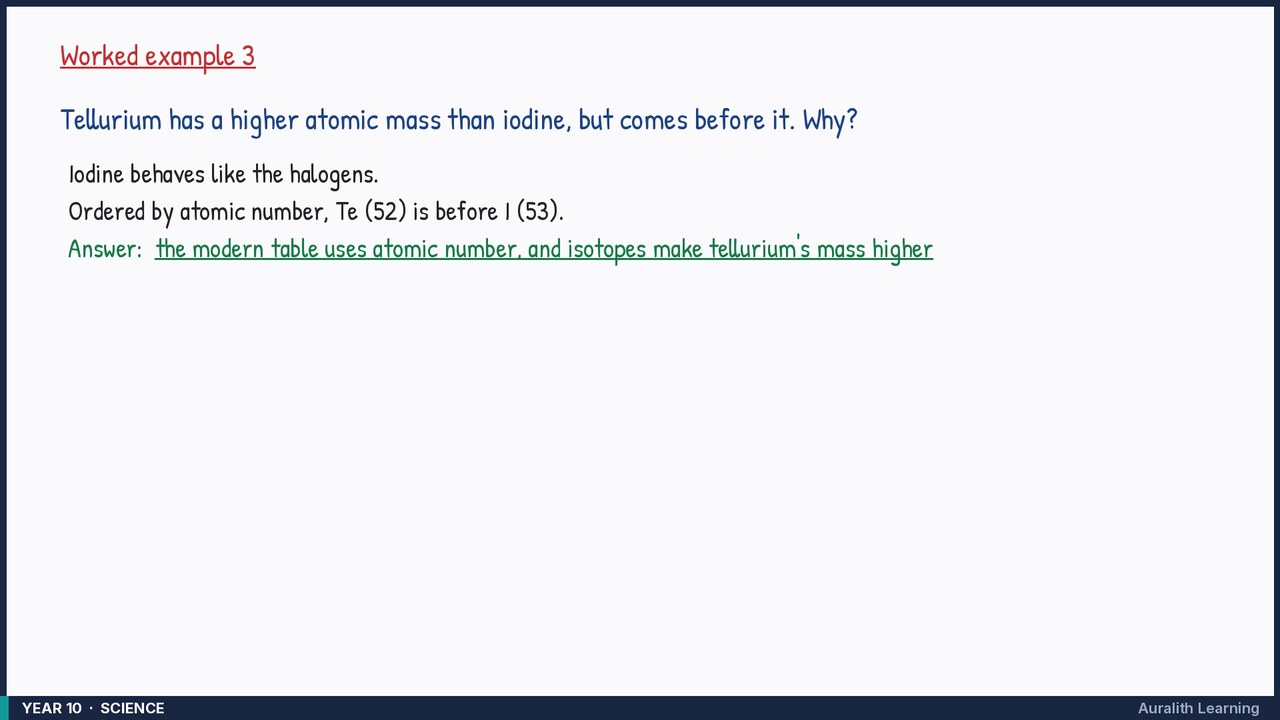
Tellurium has a higher atomic mass than iodine, but comes before it. Why?
- Step 1: Iodine behaves like the halogens.
- Step 2: Ordered by atomic number, Te (52) is before I (53).
Answer: the modern table uses atomic number, and isotopes make tellurium's mass higher