Year 10 (ages 14–15, Grade 9 in the US) · Science · Chemistry: atomic structure and the periodic table · Lesson 2
Isotopes and relative atomic mass
What isotopes are, why they have the same chemical properties, and how to calculate relative atomic mass from isotope masses and abundances.
Exam boards: this lesson matches the AQA and Pearson Edexcel GCSE science courses. Check which course your school follows.
10-minute video lesson
Teaching, worked examples and 20 practice questions solved step by step.
Watch free for a monthWhat your child will learn
- Define isotopes
- Compare particles in isotopes
- Explain why isotopes react the same way
- Calculate relative atomic mass
The method
- Isotopes: same protons, different neutrons.
- Same electrons, so same chemistry.
- Ar = (mass × % + mass × %) ÷ 100.
- Check: Ar lies between the isotope masses, nearer the more common one.
Key words: isotope, abundance, relative atomic mass, Ar, weighted mean.
Worked examples
Worked examples from the lesson, with every step.
Question 1
Carbon-12 and carbon-14: how many neutrons in each? (atomic number 6)
- Step 1: 12 − 6 = 6
- Step 2: 14 − 6 = 8
Answer: 6 and 8
Question 2
Why do carbon-12 and carbon-14 react the same way?
- Step 1: Both have 6 electrons.
- Step 2: Reactions depend on electrons.
Answer: they have the same number of electrons
Question 3
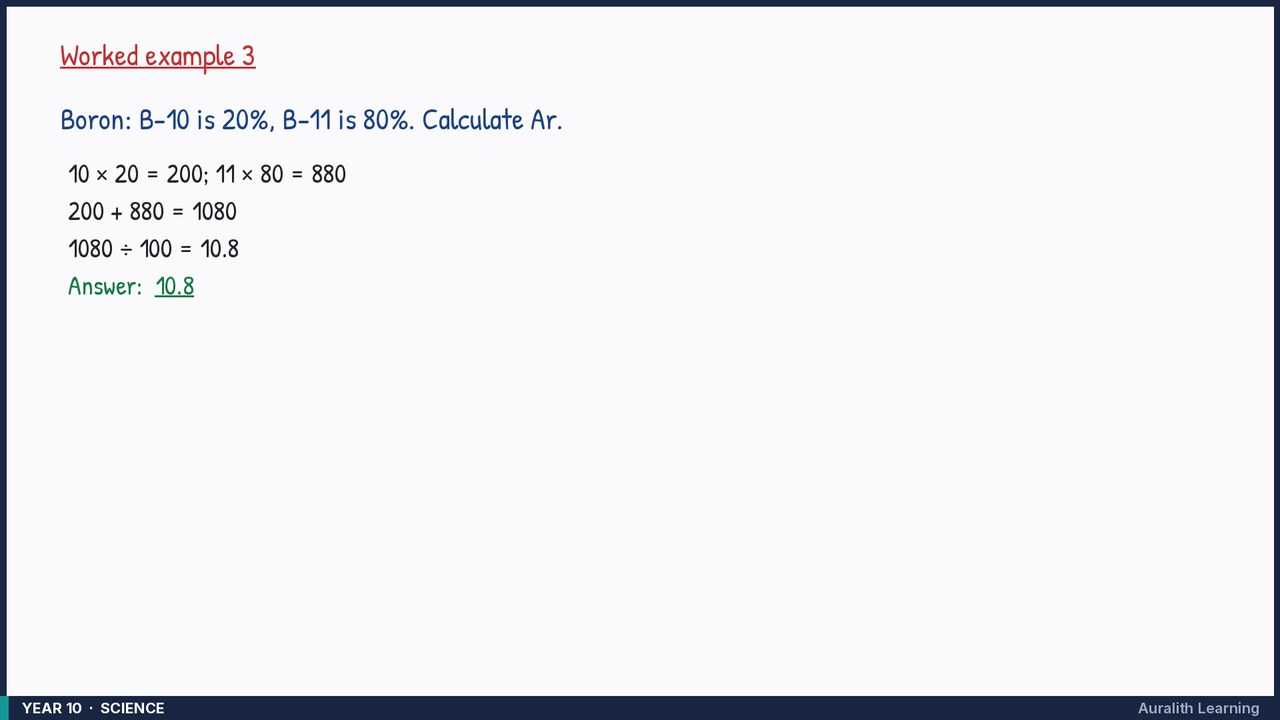
Boron: B-10 is 20%, B-11 is 80%. Calculate Ar.
- Step 1: 10 × 20 = 200; 11 × 80 = 880
- Step 2: 200 + 880 = 1080
- Step 3: 1080 ÷ 100 = 10.8
Answer: 10.8