Year 10 (ages 14–15, Grade 9 in the US) · Science · Chemistry: atomic structure and the periodic table · Lesson 1
The structure of the atom
Protons, neutrons and electrons: their relative masses, charges and positions, atomic number and mass number, working out the particles in an atom, and how the model of the atom developed.
Exam boards: this lesson matches the AQA and Pearson Edexcel GCSE science courses. Check which course your school follows.
8-minute video lesson
Teaching, worked examples and 20 practice questions solved step by step.
Watch free for a monthWhat your child will learn
- Describe the structure of an atom
- Recall relative masses and charges
- Use atomic number and mass number
- Calculate numbers of protons, neutrons and electrons
The method
- Protons = atomic number.
- Electrons = protons (neutral atom).
- Neutrons = mass number − atomic number.
- The nucleus is tiny; most of the atom is empty space.
Key words: proton, neutron, electron, atomic number, mass number.
Worked examples
Worked examples from the lesson, with every step.
Question 1
Sodium: atomic number 11, mass number 23. How many protons?
- Step 1: Protons = atomic number.
- Step 2: 11
Answer: 11
Question 2
Sodium (11, 23): how many neutrons?
- Step 1: Neutrons = mass − atomic.
- Step 2: 23 − 11 = 12
Answer: 12
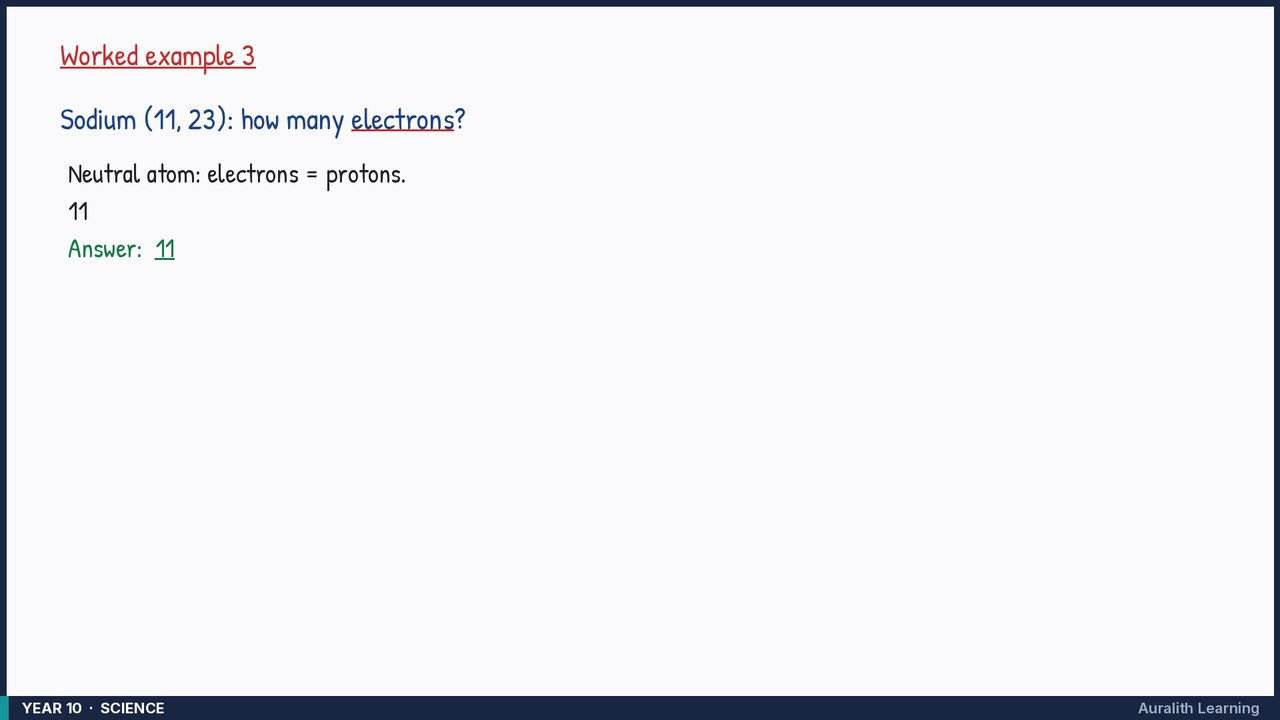
Question 3
Sodium (11, 23): how many electrons?
- Step 1: Neutral atom: electrons = protons.
- Step 2: 11
Answer: 11