Year 10 (ages 14–15, Grade 9 in the US) · Science · Chemistry: atomic structure and the periodic table · Lesson 4
Electronic configuration
How electrons fill shells (2, 8, 8), writing electronic configurations for the first 20 elements, and how configuration links to group number and period.
Exam boards: this lesson matches the AQA and Pearson Edexcel GCSE science courses. Check which course your school follows.
8-minute video lesson
Teaching, worked examples and 20 practice questions solved step by step.
Watch free for a monthWhat your child will learn
- Fill electron shells in the right order
- Write configurations for elements 1 to 20
- Link outer electrons to group number
- Link number of shells to period
The method
- Find the atomic number = number of electrons.
- Fill shells: first 2, then 8, then 8.
- Outer shell electrons = group number (Groups 1–7).
- Number of shells = period number.
Key words: shell, electronic configuration, outer electrons, group, period.
Worked examples
Worked examples from the lesson, with every step.
Question 1
Write the electronic configuration of oxygen (atomic number 8).
- Step 1: 8 electrons.
- Step 2: 2 in shell 1, 6 in shell 2.
Answer: 2.6
Question 2
Write the configuration of magnesium (12).
- Step 1: 12 electrons.
- Step 2: 2, then 8, then 2.
Answer: 2.8.2
Question 3
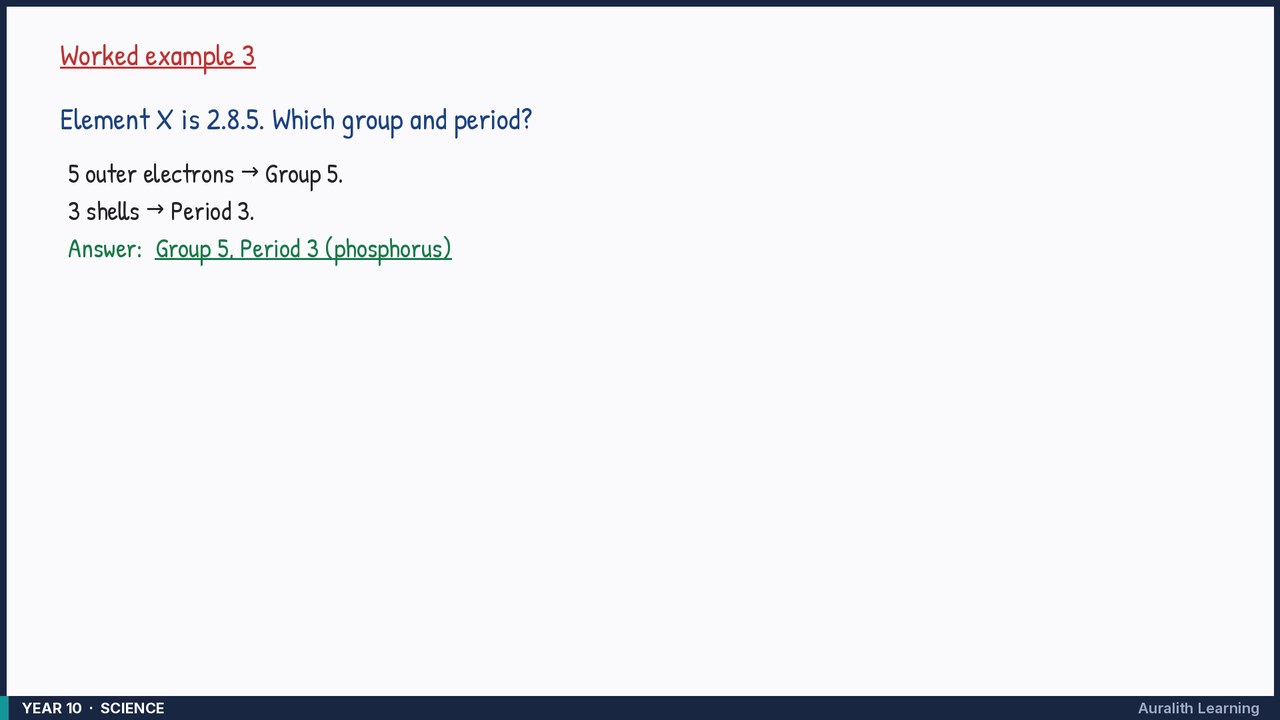
Element X is 2.8.5. Which group and period?
- Step 1: 5 outer electrons → Group 5.
- Step 2: 3 shells → Period 3.
Answer: Group 5, Period 3 (phosphorus)