Year 10 (ages 14–15, Grade 9 in the US) · Science · Chemistry: acids and electrolysis · Lesson 3
Solubility rules and insoluble salts
The general solubility rules for common salts, predicting precipitates, making an insoluble salt by precipitation, and the idea of titration for neutralising exactly.
Exam boards: this lesson matches the AQA and Pearson Edexcel GCSE science courses. Check which course your school follows.
9-minute video lesson
Teaching, worked examples and 20 practice questions solved step by step.
Watch free for a monthWhat your child will learn
- Use the solubility rules
- Predict whether a precipitate forms
- Describe how to make an insoluble salt
- Explain the purpose of a titration
The method
- All sodium, potassium, ammonium salts and all nitrates are soluble.
- Most chlorides soluble, except silver and lead.
- Most sulfates soluble, except lead, barium and calcium.
- Most carbonates and hydroxides insoluble, except sodium, potassium, ammonium.
Key words: soluble, insoluble, precipitate, precipitation, titration.
Worked examples
Worked examples from the lesson, with every step.
Question 1
Is potassium carbonate soluble or insoluble?
- Step 1: Potassium salts are all soluble.
- Step 2: Soluble.
Answer: soluble
Question 2
Is barium sulfate soluble or insoluble?
- Step 1: Most sulfates soluble, except Pb, Ba, Ca.
- Step 2: Barium is an exception.
Answer: insoluble
Question 3
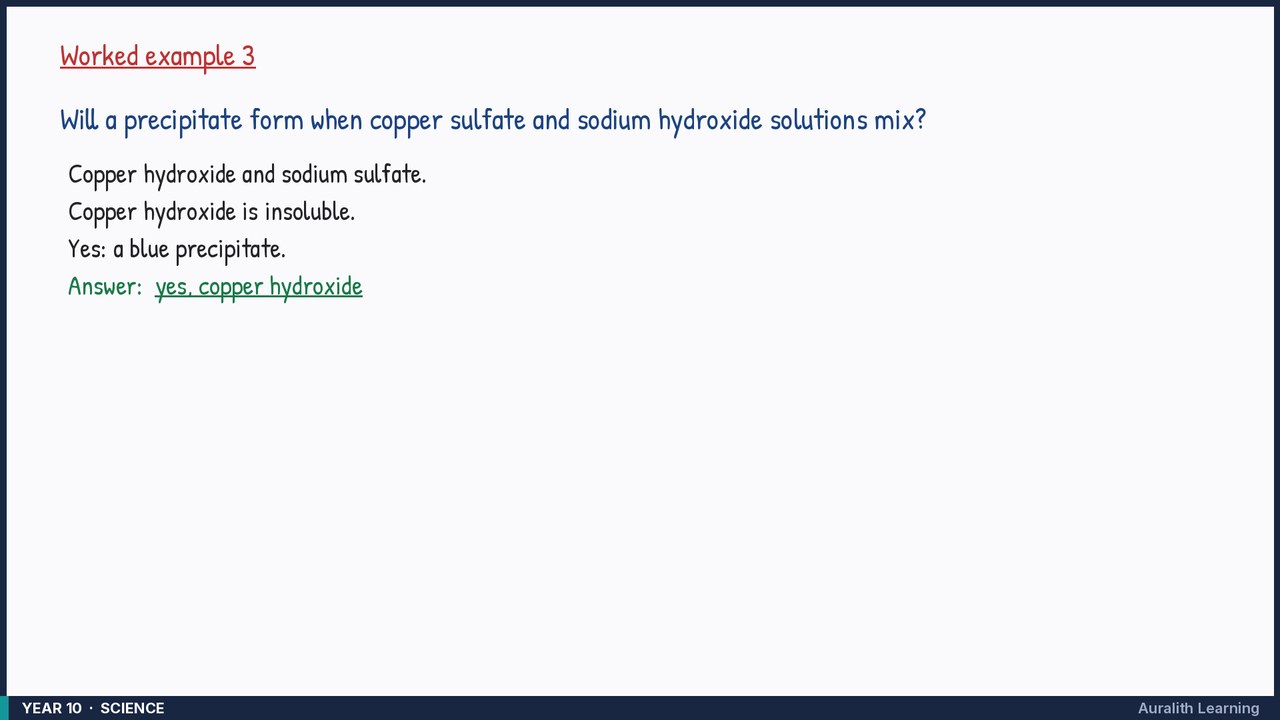
Will a precipitate form when copper sulfate and sodium hydroxide solutions mix?
- Step 1: Copper hydroxide and sodium sulfate.
- Step 2: Copper hydroxide is insoluble.
- Step 3: Yes: a blue precipitate.
Answer: yes, copper hydroxide