Year 10 (ages 14–15, Grade 9 in the US) · Science · Chemistry: acids and electrolysis · Lesson 4
Electrolysis
How electrolysis splits ionic compounds using electricity, what forms at each electrode in molten and aqueous electrolytes, oxidation and reduction, half equations (Higher), and electrolysis of copper sulfate.
Exam boards: this lesson matches the AQA and Pearson Edexcel GCSE science courses. Check which course your school follows.
8-minute video lesson
Teaching, worked examples and 20 practice questions solved step by step.
Watch free for a monthWhat your child will learn
- Explain how electrolysis works
- Predict products of molten electrolytes
- Predict products of aqueous solutions
- Write half equations (Higher)
The method
- Positive ions go to the cathode (−); negative ions to the anode (+).
- Molten: metal at cathode, non-metal at anode.
- Aqueous cathode: hydrogen forms unless the metal is less reactive than hydrogen.
- Aqueous anode: halogen if halide present; otherwise oxygen.
Key words: electrolysis, electrolyte, cathode, anode, half equation.
Worked examples
Worked examples from the lesson, with every step.
Question 1
Predict the products of electrolysing molten potassium iodide.
- Step 1: Metal: potassium.
- Step 2: Non-metal: iodine.
Answer: potassium at the cathode, iodine at the anode
Question 2
Predict the cathode product for aqueous copper chloride.
- Step 1: Copper is less reactive than hydrogen.
- Step 2: Copper is deposited.
Answer: copper
Question 3
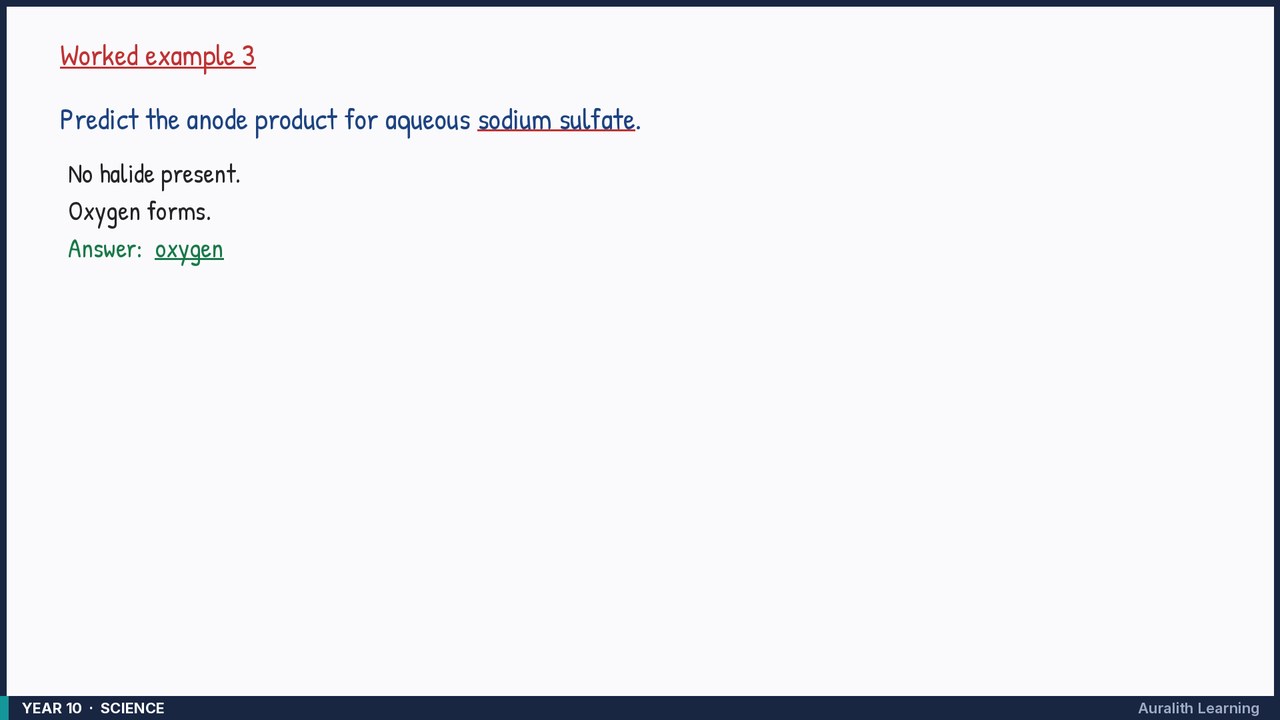
Predict the anode product for aqueous sodium sulfate.
- Step 1: No halide present.
- Step 2: Oxygen forms.
Answer: oxygen