Year 10 (ages 14–15, Grade 9 in the US) · Science · Chemistry: acids and electrolysis · Lesson 2
Reactions of acids and making salts
How acids react with metals, metal oxides, metal hydroxides and carbonates, naming the salts formed, testing for hydrogen and carbon dioxide, and making a pure, dry sample of a soluble salt.
Exam boards: this lesson matches the AQA and Pearson Edexcel GCSE science courses. Check which course your school follows.
8-minute video lesson
Teaching, worked examples and 20 practice questions solved step by step.
Watch free for a monthWhat your child will learn
- Predict products of acid reactions
- Name salts from the acid used
- Test for hydrogen and carbon dioxide
- Describe how to make a soluble salt
The method
- acid + metal → salt + hydrogen.
- acid + oxide or hydroxide → salt + water.
- acid + carbonate → salt + water + carbon dioxide.
- Hydrochloric → chloride; sulfuric → sulfate; nitric → nitrate.
Key words: salt, carbonate, effervescence, limewater, excess.
Worked examples
Worked examples from the lesson, with every step.
Question 1
Complete: magnesium + hydrochloric acid →
- Step 1: metal + acid → salt + hydrogen
- Step 2: Hydrochloric → chloride.
Answer: magnesium chloride + hydrogen
Question 2
Complete: calcium carbonate + nitric acid →
- Step 1: carbonate → salt + water + CO₂
- Step 2: Nitric → nitrate.
Answer: calcium nitrate + water + carbon dioxide
Question 3
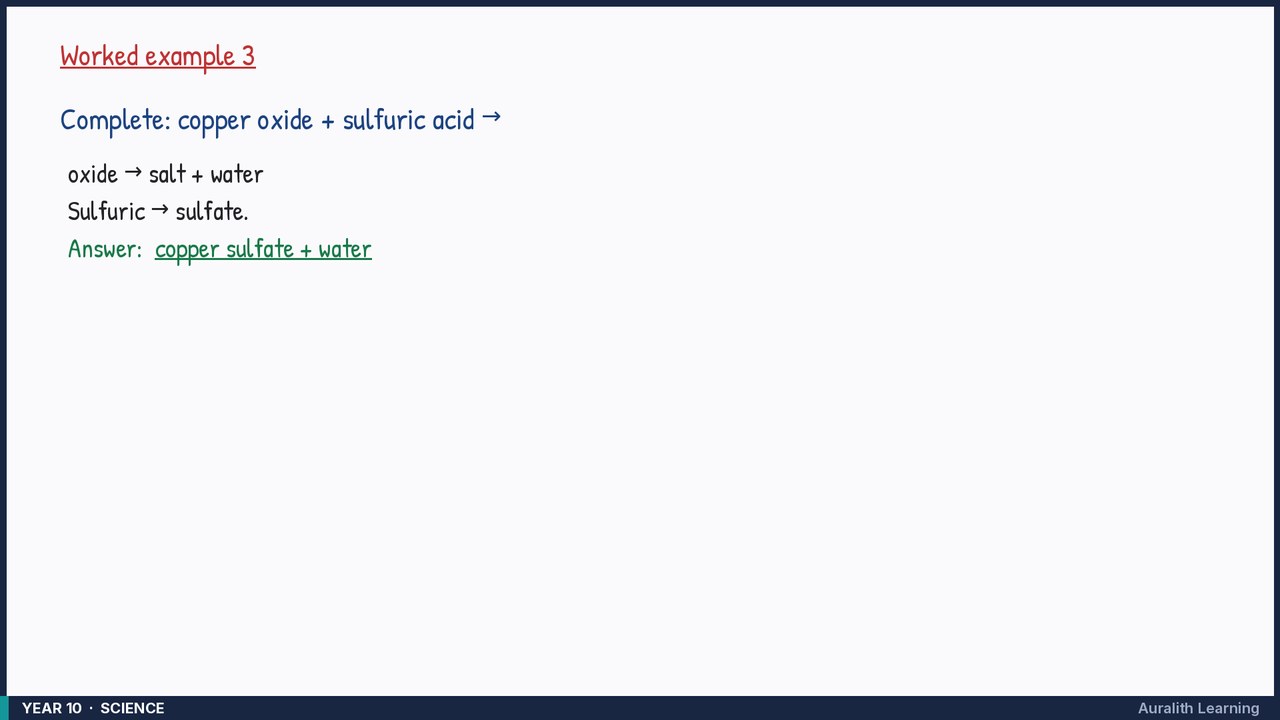
Complete: copper oxide + sulfuric acid →
- Step 1: oxide → salt + water
- Step 2: Sulfuric → sulfate.
Answer: copper sulfate + water