Year 10 (ages 14–15, Grade 9 in the US) · Science · Chemistry: acids and electrolysis · Lesson 1
Acids, alkalis and pH
Acids and alkalis in terms of hydrogen and hydroxide ions, the pH scale and indicators, neutralisation, and the difference between strong and weak, and concentrated and dilute, acids.
Exam boards: this lesson matches the AQA and Pearson Edexcel GCSE science courses. Check which course your school follows.
9-minute video lesson
Teaching, worked examples and 20 practice questions solved step by step.
Watch free for a monthWhat your child will learn
- Define acids and alkalis using ions
- Use the pH scale and indicators
- Write the ionic equation for neutralisation
- Distinguish strength from concentration
The method
- Acids release H⁺ ions in water; alkalis release OH⁻ ions.
- pH below 7: acidic; 7: neutral; above 7: alkaline.
- Neutralisation: H⁺ + OH⁻ → H₂O.
- Strong = fully ionised; concentrated = lots of acid per volume.
Key words: acid, alkali, pH, neutralisation, indicator.
Worked examples
Worked examples from the lesson, with every step.
Question 1
A solution has pH 3. Is it acidic, neutral or alkaline?
- Step 1: Below 7 is acidic.
- Step 2: Acidic.
Answer: acidic
Question 2
Which ion makes a solution alkaline?
- Step 1: Alkalis release it in water.
- Step 2: Hydroxide.
Answer: OH⁻ (hydroxide)
Question 3
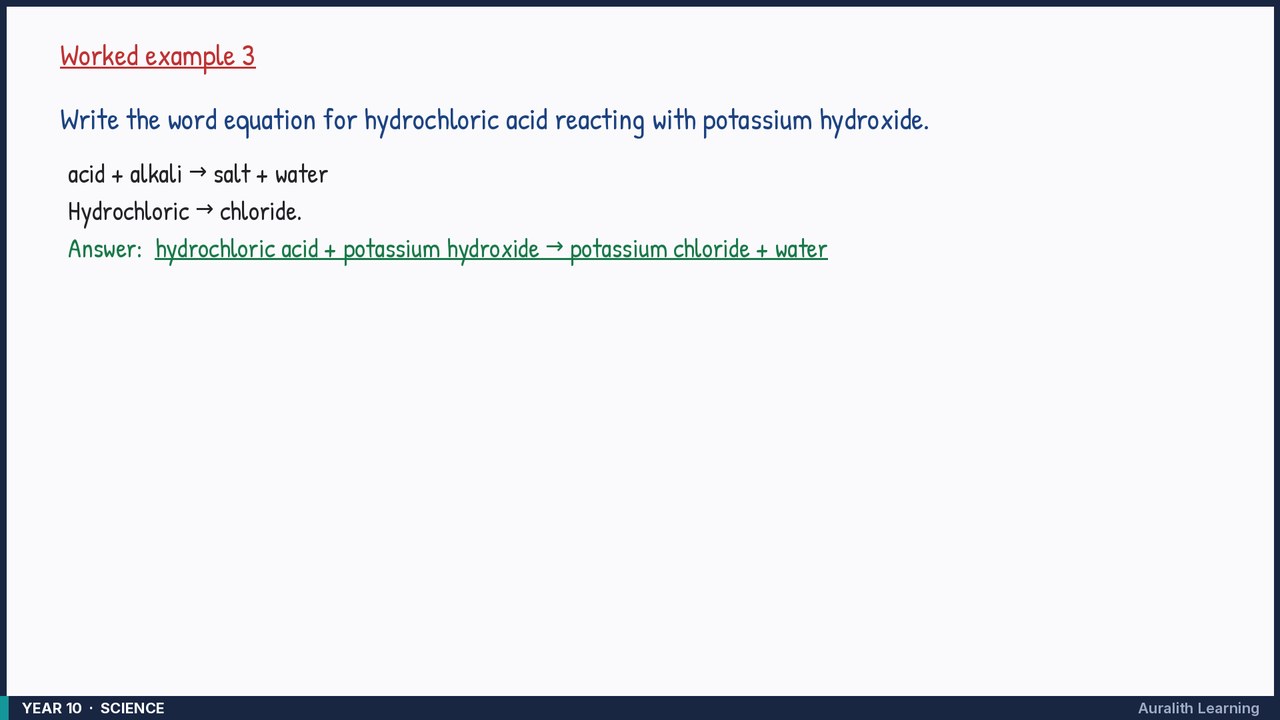
Write the word equation for hydrochloric acid reacting with potassium hydroxide.
- Step 1: acid + alkali → salt + water
- Step 2: Hydrochloric → chloride.
Answer: hydrochloric acid + potassium hydroxide → potassium chloride + water