Year 10 (ages 14–15, Grade 9 in the US) · Science · Chemistry: calculations with masses · Lesson 1
Relative formula mass and conservation of mass
Calculating relative formula mass (Mr) from relative atomic masses, the law of conservation of mass, and explaining apparent mass changes when gases are given off or taken in.
Exam boards: this lesson matches the AQA and Pearson Edexcel GCSE science courses. Check which course your school follows.
9-minute video lesson
Teaching, worked examples and 20 practice questions solved step by step.
Watch free for a monthWhat your child will learn
- Calculate relative formula mass
- Use brackets in formulae correctly
- State the law of conservation of mass
- Explain apparent changes in mass
The method
- Write each element and how many atoms.
- Multiply each Ar by the number of atoms.
- Add them up: that's Mr.
- Mass is conserved; check for gases escaping or entering.
Key words: relative formula mass, Mr, conservation of mass, closed system, balanced equation.
Worked examples
Worked examples from the lesson, with every step.
Question 1
Calculate the Mr of NaCl. (Na = 23, Cl = 35.5)
- Step 1: 23 + 35.5
- Step 2: = 58.5
Answer: 58.5
Question 2
Calculate the Mr of H₂SO₄. (H = 1, S = 32, O = 16)
- Step 1: 2 H, 1 S, 4 O.
- Step 2: 2 + 32 + 64
- Step 3: = 98
Answer: 98
Question 3
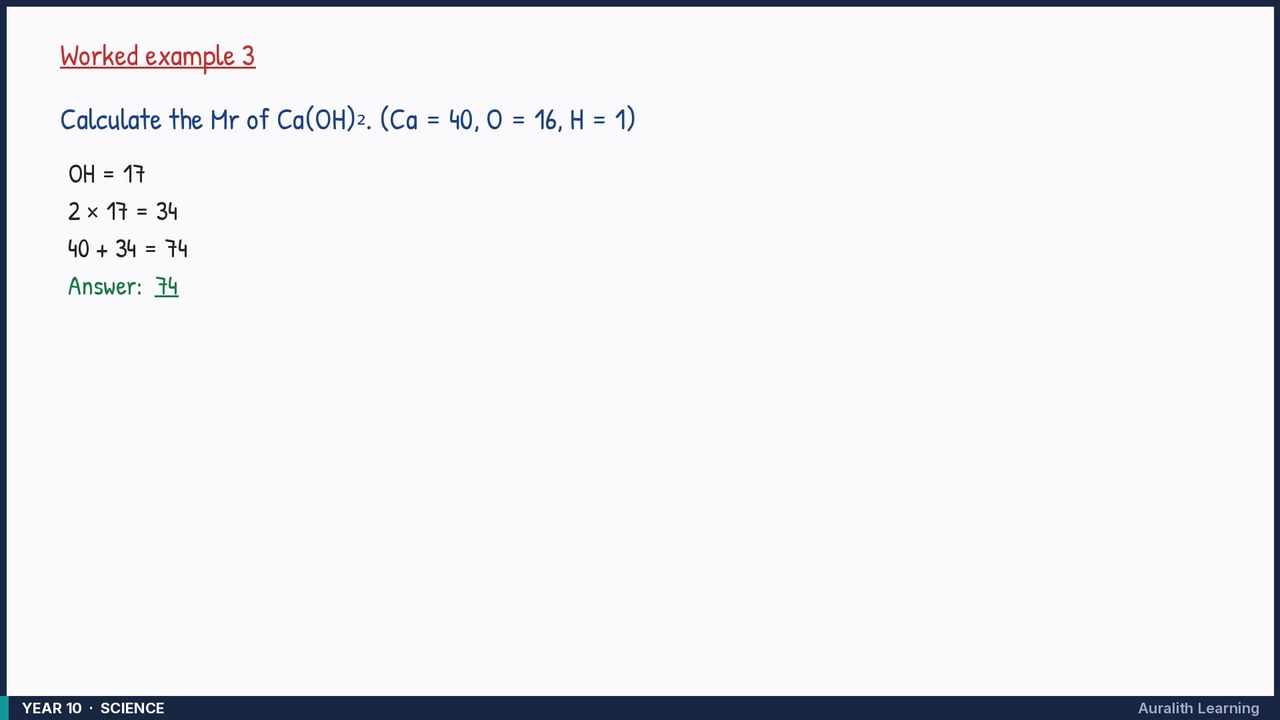
Calculate the Mr of Ca(OH)₂. (Ca = 40, O = 16, H = 1)
- Step 1: OH = 17
- Step 2: 2 × 17 = 34
- Step 3: 40 + 34 = 74
Answer: 74