Year 10 (ages 14–15, Grade 9 in the US) · Science · Chemistry: calculations with masses · Lesson 4
Moles and reacting masses (Higher)
Higher tier: the mole and the Avogadro constant, moles = mass ÷ Mr, using balanced equations to calculate reacting masses, and limiting reactants.
Exam boards: this lesson matches the AQA and Pearson Edexcel GCSE science courses. Check which course your school follows.
10-minute video lesson
Teaching, worked examples and 20 practice questions solved step by step.
Watch free for a monthWhat your child will learn
- Define the mole and the Avogadro constant
- Use moles = mass ÷ Mr
- Calculate reacting masses from equations
- Identify a limiting reactant
The method
- moles = mass ÷ Mr.
- Use the equation's ratio to find moles of the other substance.
- mass = moles × Mr.
- Limiting reactant: the one that runs out first.
Key words: mole, Avogadro constant, limiting reactant, excess, ratio.
Worked examples
Worked examples from the lesson, with every step.
Question 1
How many moles in 36 g of water? (Mr = 18)
- Step 1: moles = mass ÷ Mr
- Step 2: 36 ÷ 18 = 2
Answer: 2 mol
Question 2
What is the mass of 0.5 mol of NaCl? (Mr = 58.5)
- Step 1: mass = moles × Mr
- Step 2: 0.5 × 58.5 = 29.25
Answer: 29.25 g
Question 3
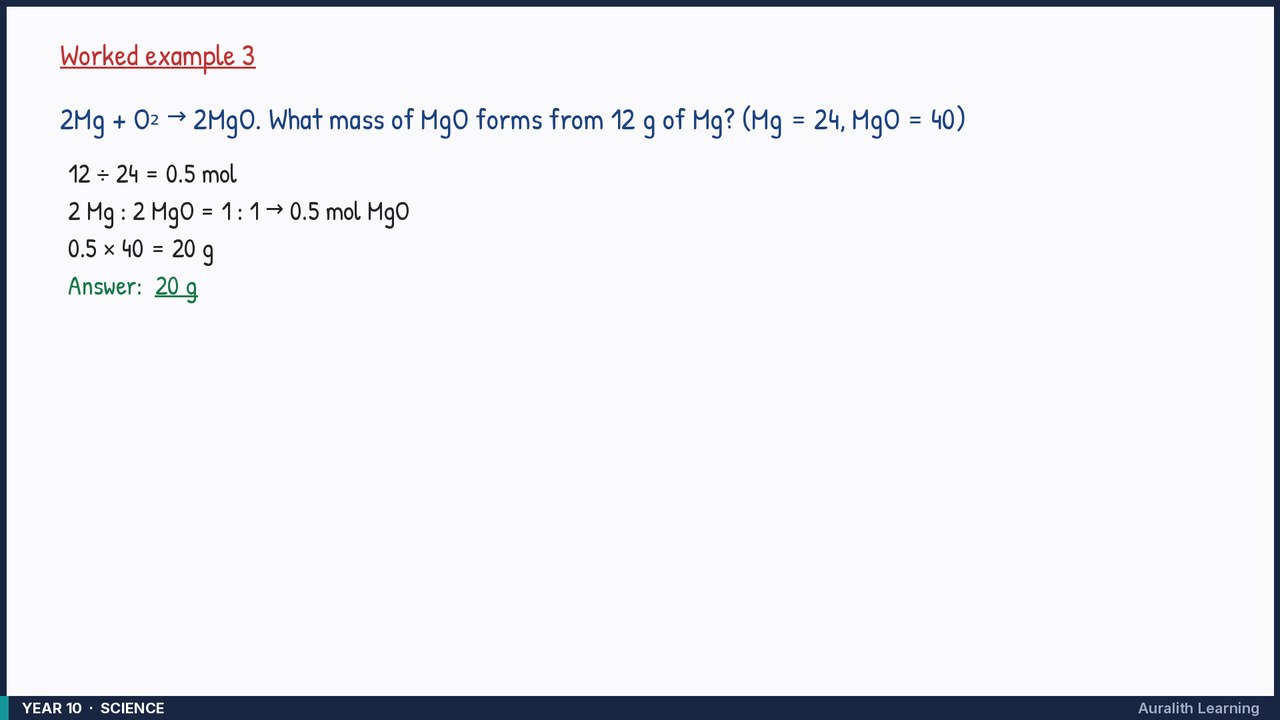
2Mg + O₂ → 2MgO. What mass of MgO forms from 12 g of Mg? (Mg = 24, MgO = 40)
- Step 1: 12 ÷ 24 = 0.5 mol
- Step 2: 2 Mg : 2 MgO = 1 : 1 → 0.5 mol MgO
- Step 3: 0.5 × 40 = 20 g
Answer: 20 g