Year 10 (ages 14–15, Grade 9 in the US) · Science · Chemistry: calculations with masses · Lesson 2
Empirical formulae and percentage by mass
Calculating the percentage by mass of an element in a compound, finding empirical formulae from masses or percentages, and the magnesium oxide experiment.
Exam boards: this lesson matches the AQA and Pearson Edexcel GCSE science courses. Check which course your school follows.
10-minute video lesson
Teaching, worked examples and 20 practice questions solved step by step.
Watch free for a monthWhat your child will learn
- Calculate percentage by mass
- Find an empirical formula from masses
- Find an empirical formula from percentages
- Describe the magnesium oxide experiment
The method
- % by mass = (Ar × number of atoms ÷ Mr) × 100.
- Empirical formula: mass ÷ Ar for each element.
- Divide by the smallest answer.
- Round to whole numbers for the ratio.
Key words: empirical formula, percentage by mass, ratio, molecular formula, crucible.
Worked examples
Worked examples from the lesson, with every step.
Question 1
Calculate the % of carbon in CO₂. (C = 12, O = 16)
- Step 1: 12 + 32 = 44
- Step 2: 12 ÷ 44 = 0.2727
- Step 3: × 100 = 27.3%
Answer: 27.3%
Question 2
Calculate the % of nitrogen in NH₄NO₃. (N = 14, H = 1, O = 16)
- Step 1: 28 + 4 + 48 = 80
- Step 2: 2 × 14 = 28
- Step 3: 28 ÷ 80 × 100 = 35%
Answer: 35%
Question 3
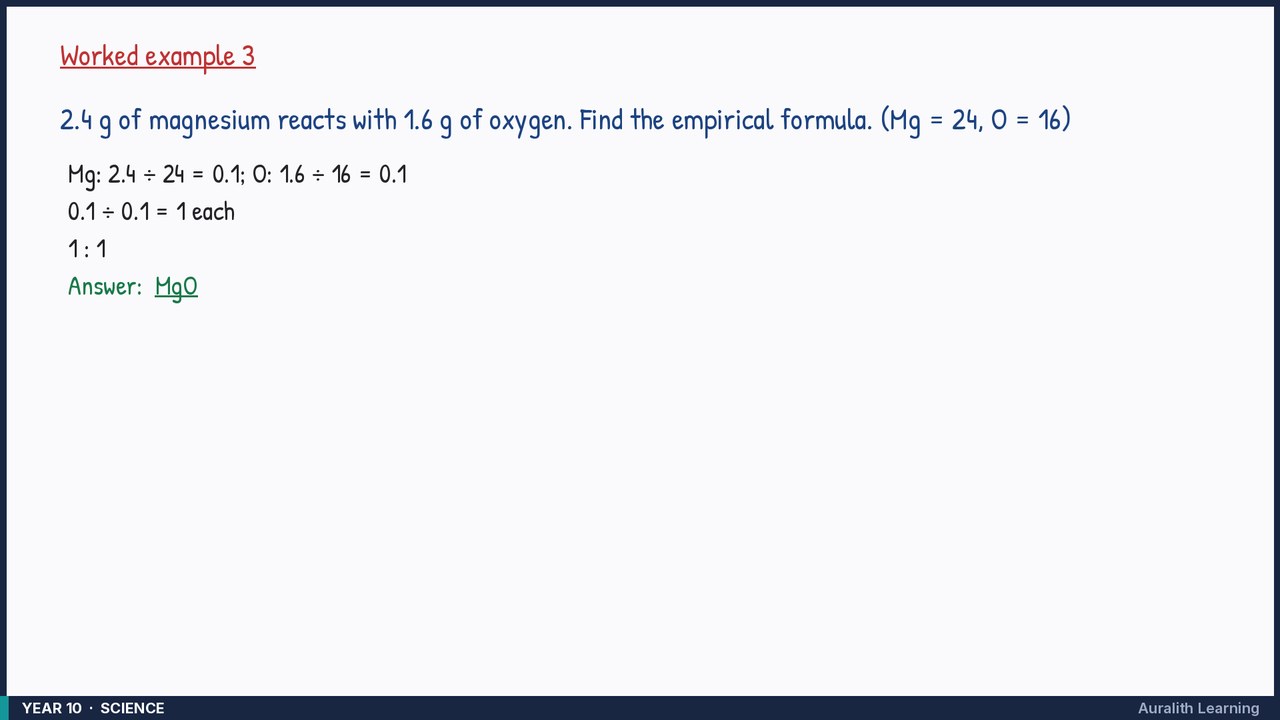
2.4 g of magnesium reacts with 1.6 g of oxygen. Find the empirical formula. (Mg = 24, O = 16)
- Step 1: Mg: 2.4 ÷ 24 = 0.1; O: 1.6 ÷ 16 = 0.1
- Step 2: 0.1 ÷ 0.1 = 1 each
- Step 3: 1 : 1
Answer: MgO