Year 10 (ages 14–15, Grade 9 in the US) · Science · Chemistry: calculations with masses · Lesson 3
Concentration of solutions
Calculating concentration in g/dm³, converting between cm³ and dm³, rearranging to find mass or volume, and how concentration affects how much solute is present.
Exam boards: this lesson matches the AQA and Pearson Edexcel GCSE science courses. Check which course your school follows.
9-minute video lesson
Teaching, worked examples and 20 practice questions solved step by step.
Watch free for a monthWhat your child will learn
- Convert between cm³ and dm³
- Calculate concentration in g/dm³
- Rearrange to find mass or volume
- Compare solutions by concentration
The method
- Convert volume to dm³: cm³ ÷ 1000.
- Concentration = mass (g) ÷ volume (dm³).
- Mass = concentration × volume.
- Volume = mass ÷ concentration.
Key words: concentration, solute, solvent, dm³, cm³.
Worked examples
Worked examples from the lesson, with every step.
Question 1
Convert 500 cm³ to dm³.
- Step 1: ÷ 1000
- Step 2: 500 ÷ 1000 = 0.5
Answer: 0.5 dm³
Question 2
20 g of salt is dissolved to make 0.5 dm³ of solution. Find the concentration.
- Step 1: conc = mass ÷ volume
- Step 2: 20 ÷ 0.5 = 40
Answer: 40 g/dm³
Question 3
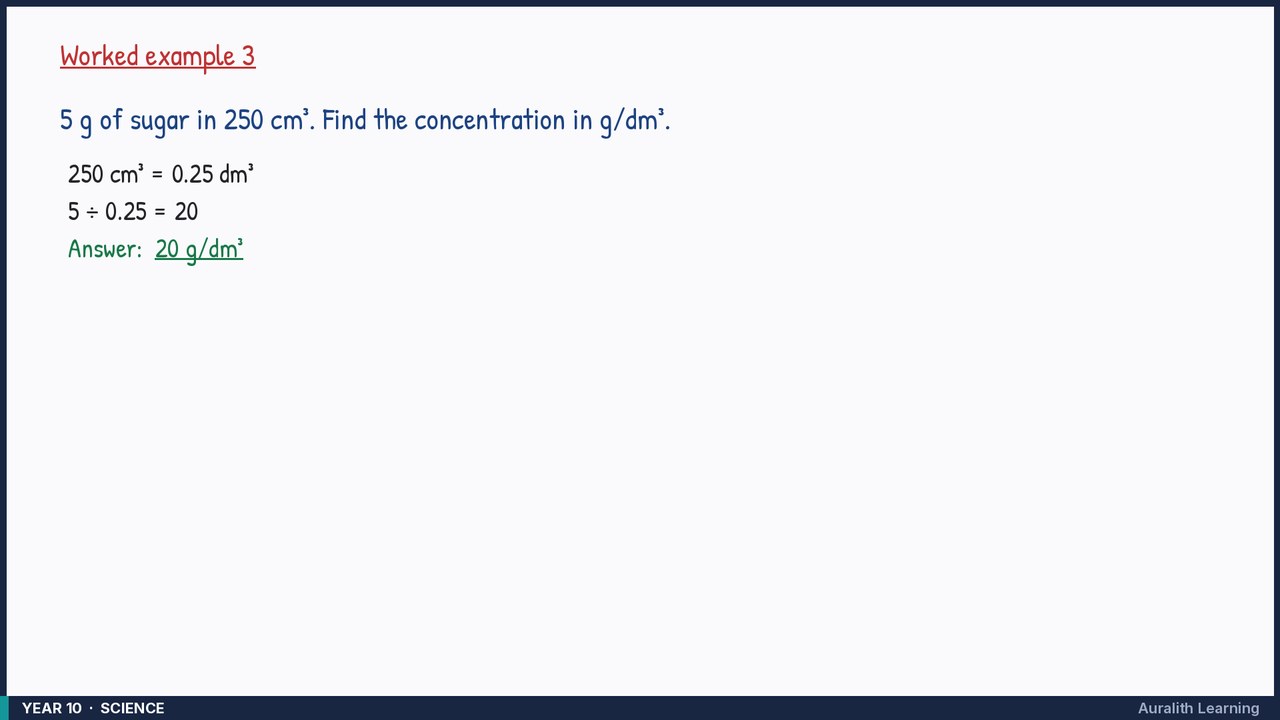
5 g of sugar in 250 cm³. Find the concentration in g/dm³.
- Step 1: 250 cm³ = 0.25 dm³
- Step 2: 5 ÷ 0.25 = 20
Answer: 20 g/dm³