Year 10 (ages 14–15, Grade 9 in the US) · Science · Biology: health, disease and medicines · Lesson 1
Health, pathogens and communicable diseases
What health means, communicable and non-communicable diseases, the four types of pathogen, and the causes, symptoms and spread of cholera, tuberculosis, malaria, HIV, Chalara ash dieback and stomach ulcers.
Exam boards: this lesson matches the AQA and Pearson Edexcel GCSE science courses. Check which course your school follows.
9-minute video lesson
Teaching, worked examples and 20 practice questions solved step by step.
Watch free for a monthWhat your child will learn
- Define health and disease
- Distinguish communicable and non-communicable diseases
- Name the four types of pathogen
- Describe key diseases and how they spread
The method
- Name the pathogen type.
- State how it spreads.
- Give the main symptoms.
- Suggest how to reduce the spread.
Key words: pathogen, communicable, virus, protist, vector.
Worked examples
Worked examples from the lesson, with every step.
Question 1
Is a cold communicable or non-communicable?
- Step 1: Caused by a virus.
- Step 2: Passes between people.
Answer: communicable
Question 2
Name the pathogen type that causes malaria and its vector.
- Step 1: A protist.
- Step 2: Mosquitoes carry it.
Answer: a protist, carried by mosquitoes
Question 3
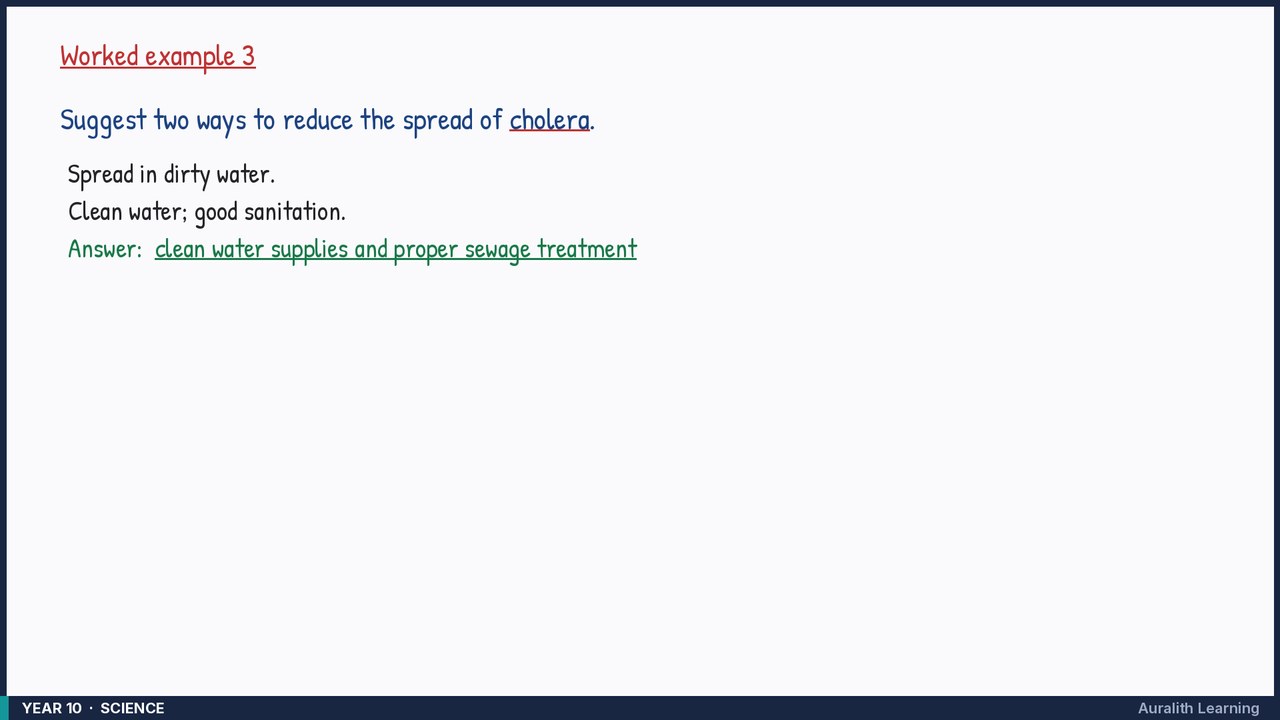
Suggest two ways to reduce the spread of cholera.
- Step 1: Spread in dirty water.
- Step 2: Clean water; good sanitation.
Answer: clean water supplies and proper sewage treatment