Year 10 (ages 14–15, Grade 9 in the US) · Science · Biology: health, disease and medicines · Lesson 3
Antibiotics and developing new medicines
How antibiotics work and why they don't treat viruses, and how new medicines are discovered and tested: preclinical tests on cells and animals, then clinical trials with placebos and double-blind design.
Exam boards: this lesson matches the AQA and Pearson Edexcel GCSE science courses. Check which course your school follows.
9-minute video lesson
Teaching, worked examples and 20 practice questions solved step by step.
Watch free for a monthWhat your child will learn
- Explain what antibiotics do
- Describe the stages of drug development
- Explain placebos and double-blind trials
- Explain why testing is needed
The method
- Antibiotics kill bacteria or stop their growth, not viruses.
- Discovery → preclinical (cells, tissues, animals) → clinical trials.
- Trials check safety first, then effectiveness and dose.
- Double-blind: neither patients nor doctors know who gets the drug.
Key words: antibiotic, preclinical, clinical trial, placebo, double-blind.
Worked examples
Worked examples from the lesson, with every step.
Question 1
Why won't a doctor give antibiotics for flu?
- Step 1: Flu is caused by a virus.
- Step 2: They only affect bacteria.
Answer: antibiotics don't work on viruses
Question 2
Put in order: clinical trials, discovery, animal tests, tests on cells.
- Step 1: Discovery comes first.
- Step 2: Cells → animals → people.
Answer: discovery, tests on cells, animal tests, clinical trials
Question 3
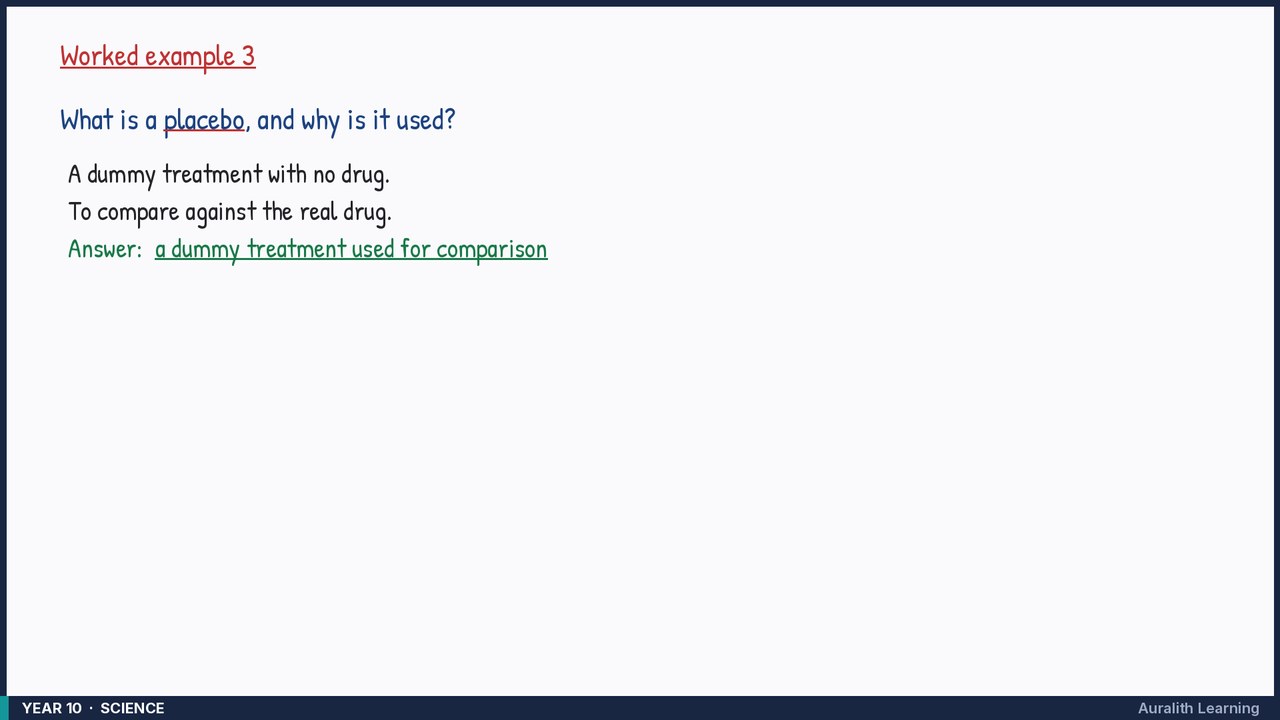
What is a placebo, and why is it used?
- Step 1: A dummy treatment with no drug.
- Step 2: To compare against the real drug.
Answer: a dummy treatment used for comparison