Year 10 (ages 14–15, Grade 9 in the US) · Science · Biology: health, disease and medicines · Lesson 4
Non-communicable diseases and lifestyle
Risk factors for non-communicable diseases, calculating BMI and waist-to-hip ratio, the effects of alcohol and smoking, and treatments for cardiovascular disease: life changes, medicines and surgery.
Exam boards: this lesson matches the AQA and Pearson Edexcel GCSE science courses. Check which course your school follows.
9-minute video lesson
Teaching, worked examples and 20 practice questions solved step by step.
Watch free for a monthWhat your child will learn
- Explain what a risk factor is
- Calculate BMI and waist-to-hip ratio
- Describe effects of alcohol and smoking
- Evaluate treatments for cardiovascular disease
The method
- BMI = mass (kg) ÷ height² (m²).
- Waist : hip = waist ÷ hip.
- Risk factors increase the chance, not certainty, of disease.
- Treatments: lifestyle, medicines, surgery — weigh pros and cons.
Key words: risk factor, BMI, cardiovascular, statins, stent.
Worked examples
Worked examples from the lesson, with every step.
Question 1
Calculate the BMI of a person with mass 72 kg and height 1.8 m.
- Step 1: 1.8² = 3.24
- Step 2: 72 ÷ 3.24 = 22.2
Answer: 22.2 (healthy range)
Question 2
Calculate the waist : hip ratio for waist 90 cm and hip 100 cm.
- Step 1: 90 ÷ 100
- Step 2: = 0.9
Answer: 0.9
Question 3
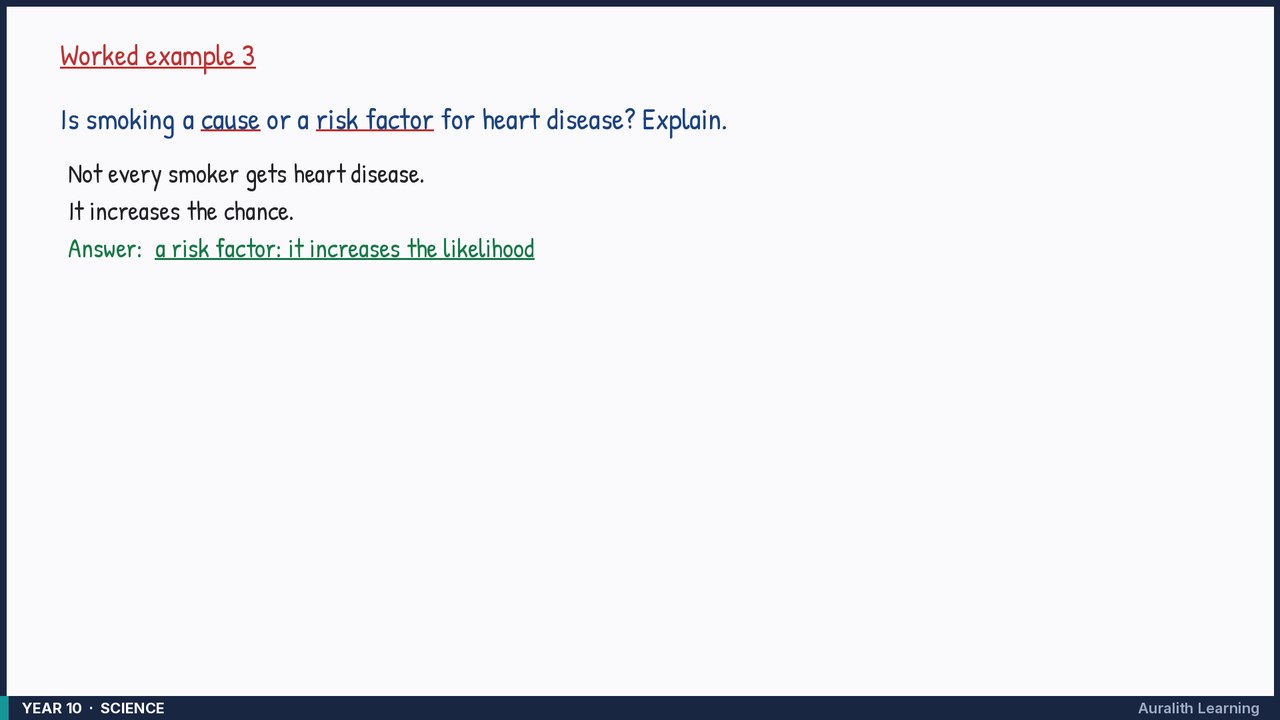
Is smoking a cause or a risk factor for heart disease? Explain.
- Step 1: Not every smoker gets heart disease.
- Step 2: It increases the chance.
Answer: a risk factor: it increases the likelihood