Year 10 (ages 14–15, Grade 9 in the US) · Science · Biology: health, disease and medicines · Lesson 2
Body defences and the immune system
How the body stops pathogens getting in (physical and chemical barriers), how white blood cells and antibodies fight infection, how memory lymphocytes give immunity, and how vaccination works.
Exam boards: this lesson matches the AQA and Pearson Edexcel GCSE science courses. Check which course your school follows.
9-minute video lesson
Teaching, worked examples and 20 practice questions solved step by step.
Watch free for a monthWhat your child will learn
- Describe physical and chemical barriers
- Explain how antibodies work
- Explain the primary and secondary response
- Explain how vaccination and herd immunity work
The method
- Barriers keep pathogens out.
- Lymphocytes make antibodies that fit the pathogen's antigens.
- Memory cells give a faster, bigger second response.
- Vaccines trigger memory cells without causing illness.
Key words: antibody, antigen, lymphocyte, memory cell, vaccination.
Worked examples
Worked examples from the lesson, with every step.
Question 1
How does mucus protect the lungs?
- Step 1: Mucus is sticky and traps pathogens.
- Step 2: Cilia sweep it up and away.
Answer: it traps pathogens, which cilia then sweep away
Question 2
What is an antigen?
- Step 1: On the surface of a pathogen.
- Step 2: Antibodies recognise it.
Answer: a molecule on a pathogen's surface that antibodies recognise
Question 3
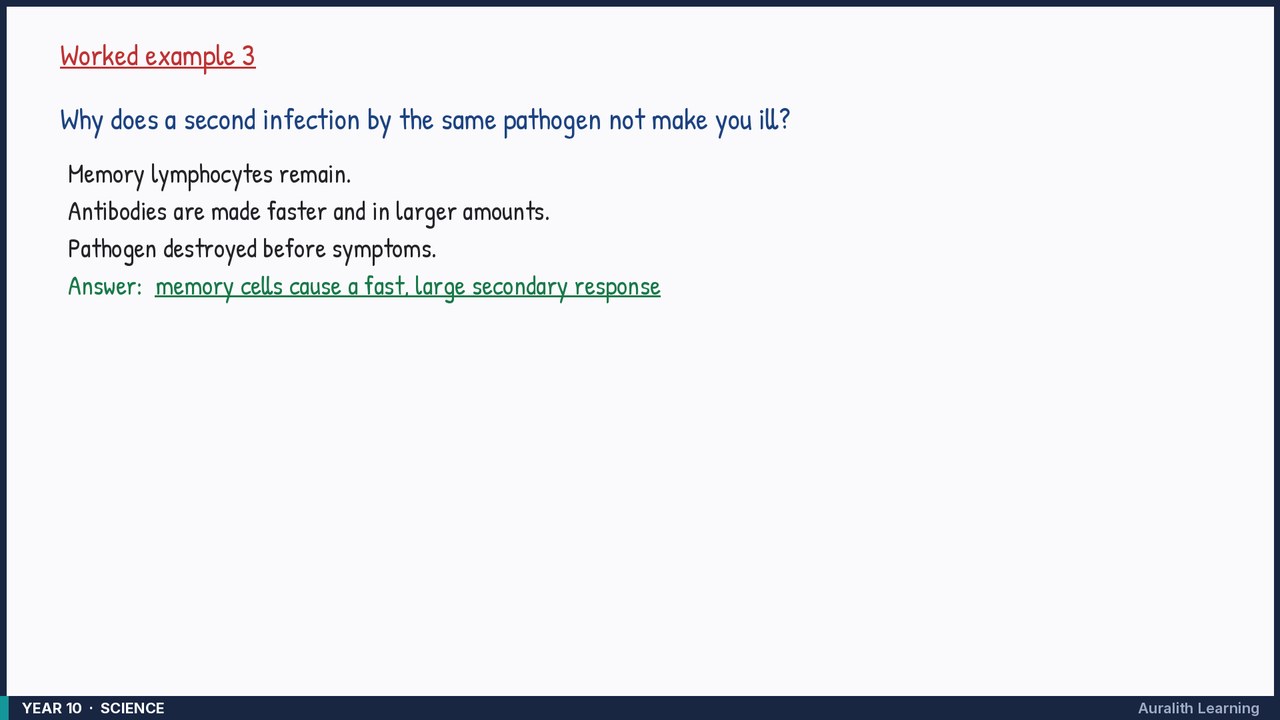
Why does a second infection by the same pathogen not make you ill?
- Step 1: Memory lymphocytes remain.
- Step 2: Antibodies are made faster and in larger amounts.
- Step 3: Pathogen destroyed before symptoms.
Answer: memory cells cause a fast, large secondary response