Year 10 (ages 14–15, Grade 9 in the US) · Maths · Statistics · Lesson 3
Sampling
Understand populations and samples, identify bias, choose random and stratified samples, and estimate a population with capture–recapture (made-up numbers).
Exam boards: this lesson matches the AQA and Pearson Edexcel GCSE maths courses. Check which course your school follows.
9-minute video lesson
Teaching, worked examples and 20 practice questions solved step by step.
Watch free for a monthWhat your child will learn
- Define population and sample
- Identify sources of bias
- Calculate a stratified sample
- Use capture–recapture
The method
- Population: everyone. Sample: a part.
- Random: everyone has an equal chance.
- Avoid bias: be representative.
- Stratified: group ÷ total × sample size.
Key words: population, sample, bias, random, stratified.
Worked examples
Worked examples from the lesson, with every step.
Question 1
A school has 360 boys and 240 girls. A stratified sample of 50 is taken. How many boys?
- Step 1: 360 ÷ 600 × 50
Answer: 30
Question 2
A school has Year 7: 150, Year 8: 120, Year 9: 130. A stratified sample of 80 is taken. How many from Year 8?
- Step 1: 120 ÷ 400 × 80
Answer: 24
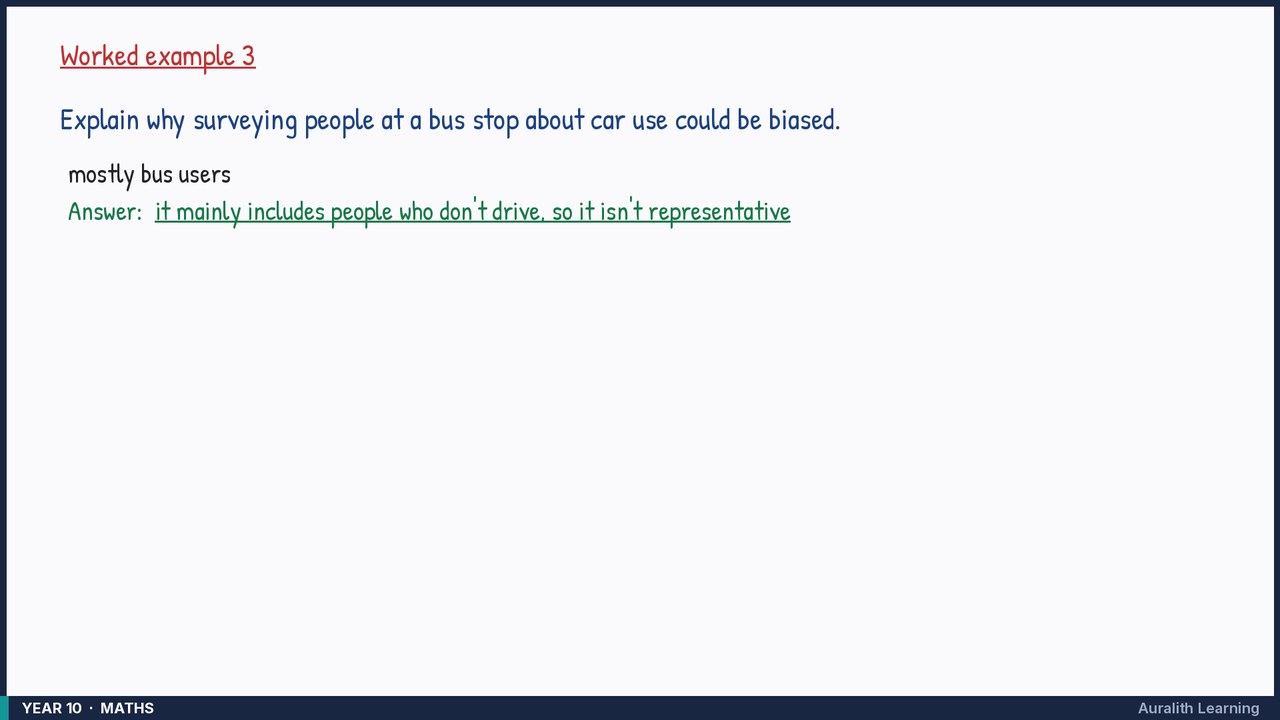
Question 3
Explain why surveying people at a bus stop about car use could be biased.
- Step 1: mostly bus users
Answer: it mainly includes people who don't drive, so it isn't representative