Year 11 (ages 15–16, Grade 10 in the US) · Science · Chemistry: organic chemistry and the atmosphere · Lesson 3
The atmosphere, greenhouse gases and pollution
The composition of today's atmosphere, how the early atmosphere changed over billions of years, the greenhouse effect and human impacts on climate, and common atmospheric pollutants and their effects.
Exam boards: this lesson matches the AQA and Pearson Edexcel GCSE science courses. Check which course your school follows.
8-minute video lesson
Teaching, worked examples and 20 practice questions solved step by step.
Watch free for a monthWhat your child will learn
- State the composition of today's atmosphere
- Explain how the atmosphere has changed
- Explain the greenhouse effect
- Describe atmospheric pollutants and their effects
The method
- Today: about 78% nitrogen, 21% oxygen, small amounts of others.
- Early atmosphere: mostly CO₂ from volcanoes.
- Oxygen came from photosynthesis by algae and plants.
- Greenhouse gases trap heat; extra emissions cause warming.
Key words: atmosphere, greenhouse gas, climate change, carbon footprint, pollutant.
Worked examples
Worked examples from the lesson, with every step.
Question 1
What are the two main gases in today's atmosphere?
- Step 1: Nitrogen, about 78%.
- Step 2: Oxygen, about 21%.
Answer: nitrogen and oxygen
Question 2
Explain how oxygen levels increased in the atmosphere.
- Step 1: Algae and plants evolved.
- Step 2: Photosynthesis released oxygen.
Answer: photosynthesis by algae and plants
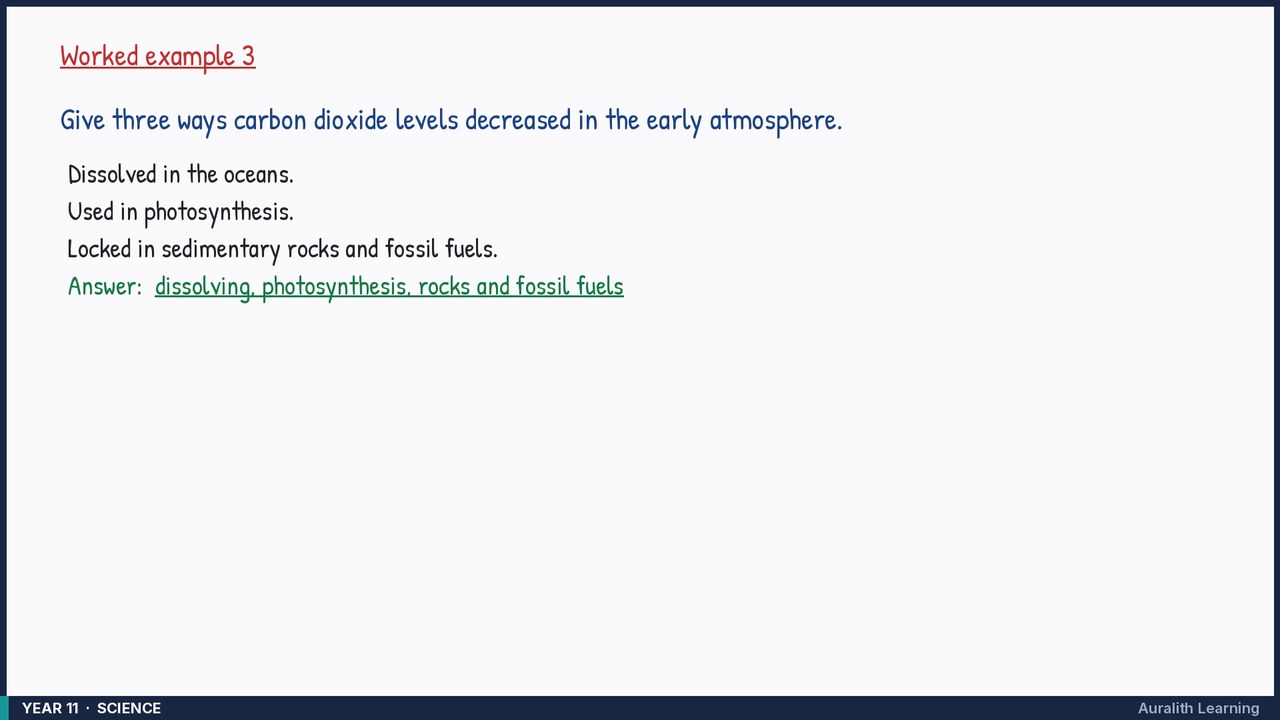
Question 3
Give three ways carbon dioxide levels decreased in the early atmosphere.
- Step 1: Dissolved in the oceans.
- Step 2: Used in photosynthesis.
- Step 3: Locked in sedimentary rocks and fossil fuels.
Answer: dissolving, photosynthesis, rocks and fossil fuels