Year 11 (ages 15–16, Grade 10 in the US) · Science · Chemistry: organic chemistry and the atmosphere · Lesson 1
Crude oil, alkanes and fractional distillation
What crude oil is and how it formed, the alkane homologous series, separating crude oil by fractional distillation, how properties change with chain length, and complete and incomplete combustion.
Exam boards: this lesson matches the AQA and Pearson Edexcel GCSE science courses. Check which course your school follows.
8-minute video lesson
Teaching, worked examples and 20 practice questions solved step by step.
Watch free for a monthWhat your child will learn
- Describe crude oil and alkanes
- Explain fractional distillation
- Describe how properties change with chain length
- Compare complete and incomplete combustion
The method
- Crude oil: a mixture of hydrocarbons, mostly alkanes.
- Alkanes: CₙH₂ₙ₊₂ — methane, ethane, propane, butane.
- Fractional distillation separates by boiling point.
- Longer chains: higher boiling point, more viscous, less flammable.
Key words: hydrocarbon, alkane, fraction, viscosity, combustion.
Worked examples
Worked examples from the lesson, with every step.
Question 1
Use the general formula to find the formula of the alkane with 5 carbon atoms.
- Step 1: CₙH₂ₙ₊₂ with n = 5
- Step 2: 2 × 5 + 2 = 12
Answer: C₅H₁₂
Question 2
Explain how fractional distillation separates crude oil.
- Step 1: Crude oil is vaporised.
- Step 2: Vapour rises and cools.
- Step 3: Fractions condense at their boiling points.
Answer: by boiling point, in a temperature gradient
Question 3
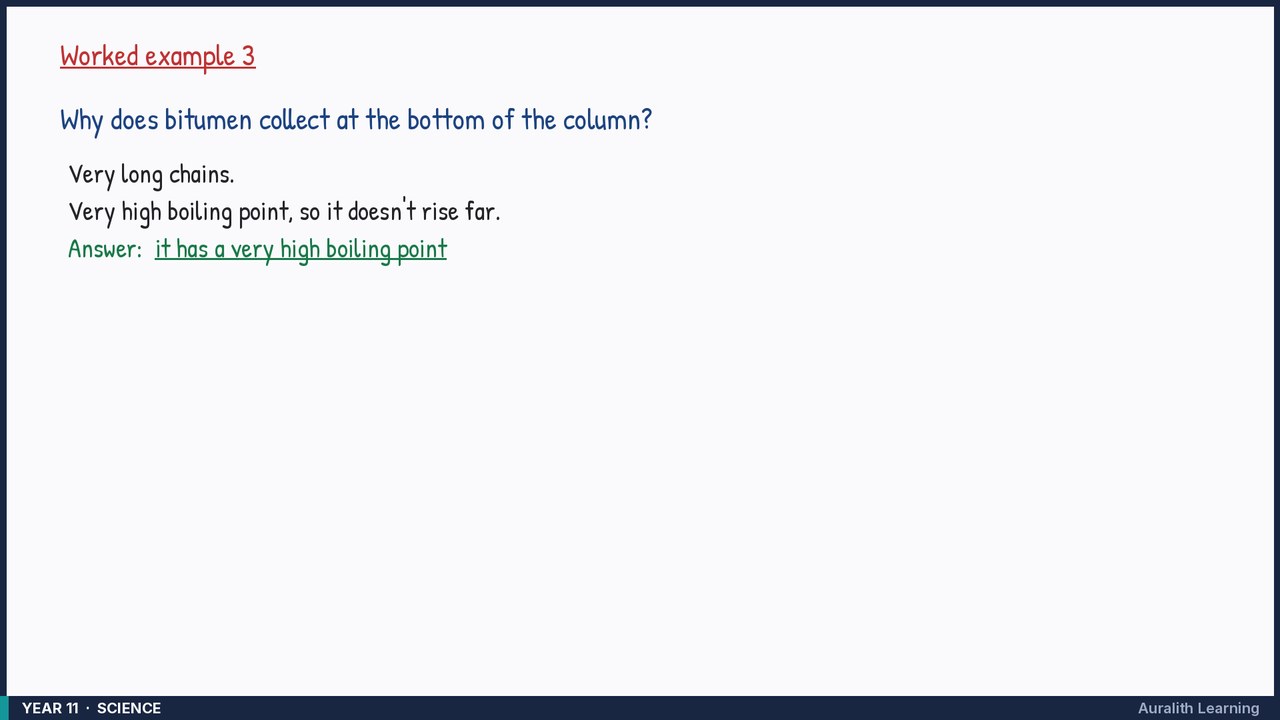
Why does bitumen collect at the bottom of the column?
- Step 1: Very long chains.
- Step 2: Very high boiling point, so it doesn't rise far.
Answer: it has a very high boiling point