Year 11 (ages 15–16, Grade 10 in the US) · Science · Chemistry: organic chemistry and the atmosphere · Lesson 2
Cracking, alkenes and polymers
Why and how long-chain hydrocarbons are cracked, the alkene homologous series and the bromine water test, addition polymerisation of ethene into poly(ethene), and issues with disposing of plastics.
Exam boards: this lesson matches the AQA and Pearson Edexcel GCSE science courses. Check which course your school follows.
8-minute video lesson
Teaching, worked examples and 20 practice questions solved step by step.
Watch free for a monthWhat your child will learn
- Explain why and how cracking is done
- Describe alkenes and test for them
- Explain addition polymerisation
- Evaluate problems with plastic waste
The method
- Cracking breaks long alkanes into shorter alkanes and alkenes.
- Alkenes have a C=C double bond: CₙH₂ₙ.
- Bromine water: orange → colourless with an alkene.
- Many alkene monomers join to make a polymer.
Key words: cracking, alkene, unsaturated, polymer, monomer.
Worked examples
Worked examples from the lesson, with every step.
Question 1
Why do oil refineries crack long-chain hydrocarbons?
- Step 1: Too much long-chain fraction.
- Step 2: More demand for petrol and for alkenes to make plastics.
Answer: to meet demand for shorter, more useful molecules
Question 2
Complete: C₁₂H₂₆ → C₈H₁₈ + ?
- Step 1: 12 − 8 = 4
- Step 2: 26 − 18 = 8
Answer: C₄H₈ (butene)
Question 3
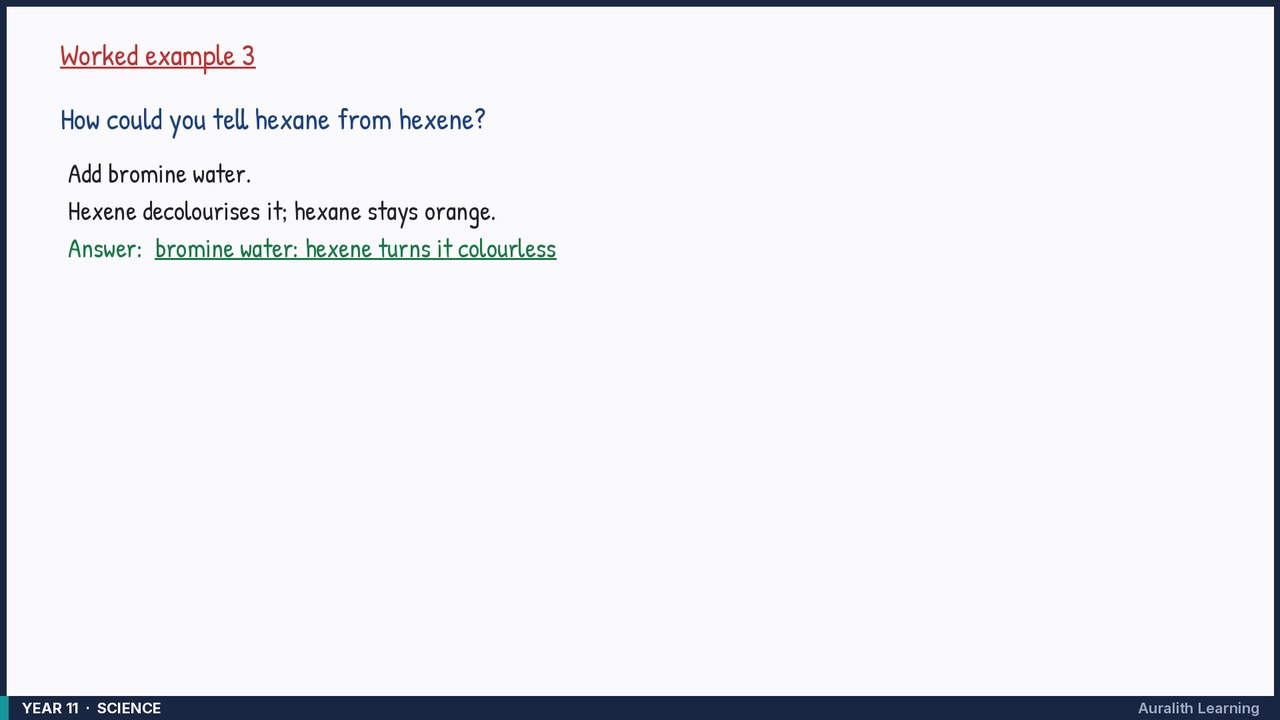
How could you tell hexane from hexene?
- Step 1: Add bromine water.
- Step 2: Hexene decolourises it; hexane stays orange.
Answer: bromine water: hexene turns it colourless