Year 11 (ages 15–16, Grade 10 in the US) · Science · Physics: particle model and forces in matter · Lesson 3
Springs, elastic energy and pressure
Elastic and inelastic deformation, Hooke's law F = ke, the limit of proportionality, elastic potential energy, pressure on surfaces p = F ÷ A, and pressure in liquids p = hρg.
Exam boards: this lesson matches the AQA and Pearson Edexcel GCSE science courses. Check which course your school follows.
9-minute video lesson
Teaching, worked examples and 20 practice questions solved step by step.
Watch free for a monthWhat your child will learn
- Use F = ke
- Calculate elastic potential energy
- Use p = F ÷ A
- Use p = hρg for liquids
The method
- F = k × e (until the limit of proportionality).
- Elastic potential energy = ½ × k × e².
- Pressure = force ÷ area (Pa = N/m²).
- Liquid pressure = height × density × g.
Key words: extension, spring constant, limit of proportionality, pressure, upthrust.
Worked examples
Worked examples from the lesson, with every step.
Question 1
A spring's length goes from 10 cm to 14 cm. Find the extension in metres.
- Step 1: 14 − 10 = 4 cm
- Step 2: 4 cm = 0.04 m
Answer: 0.04 m
Question 2
A spring with k = 25 N/m extends by 0.2 m. Find the force.
- Step 1: 25 × 0.2
Answer: 5 N
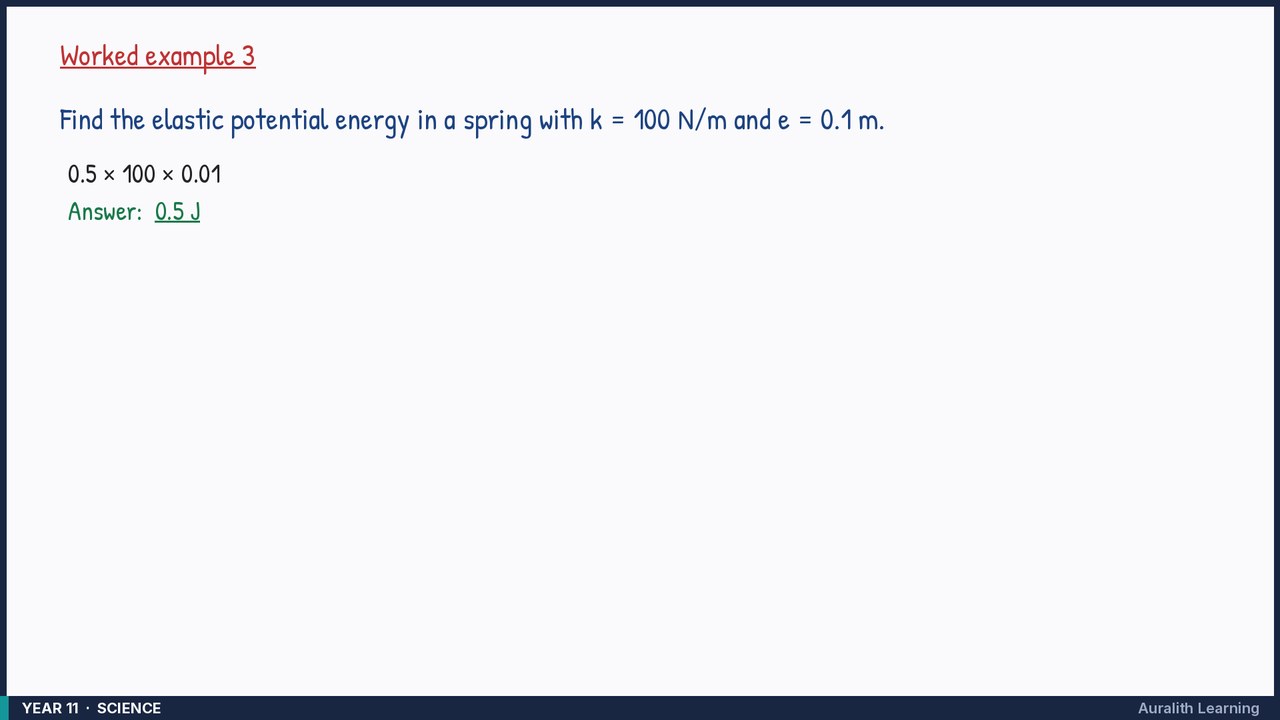
Question 3
Find the elastic potential energy in a spring with k = 100 N/m and e = 0.1 m.
- Step 1: 0.5 × 100 × 0.01
Answer: 0.5 J