Year 11 (ages 15–16, Grade 10 in the US) · Science · Physics: particle model and forces in matter · Lesson 2
Specific heat capacity and specific latent heat
Calculating the energy needed to change temperature using specific heat capacity, the energy needed to change state using specific latent heat, and interpreting heating and cooling curves.
Exam boards: this lesson matches the AQA and Pearson Edexcel GCSE science courses. Check which course your school follows.
10-minute video lesson
Teaching, worked examples and 20 practice questions solved step by step.
Watch free for a monthWhat your child will learn
- Use ΔE = mcΔθ
- Use E = mL
- Interpret heating and cooling curves
- Explain why temperature stays constant during a change of state
The method
- ΔE = m × c × Δθ (change in temperature).
- E = m × L (change of state, no temperature change).
- Flat sections on a heating curve = changes of state.
- Energy breaks bonds rather than raising temperature.
Key words: specific heat capacity, specific latent heat, fusion, vaporisation, heating curve.
Worked examples
Worked examples from the lesson, with every step.
Question 1
How much energy raises 0.5 kg of water from 20 °C to 80 °C? (c = 4200 J/kg °C)
- Step 1: 80 − 20 = 60 °C
- Step 2: 0.5 × 4200 × 60
Answer: 126 000 J
Question 2
5400 J heats 1 kg of aluminium by 6 °C. Find c.
- Step 1: c = ΔE ÷ (mΔθ)
- Step 2: 5400 ÷ (1 × 6)
Answer: 900 J/kg °C
Question 3
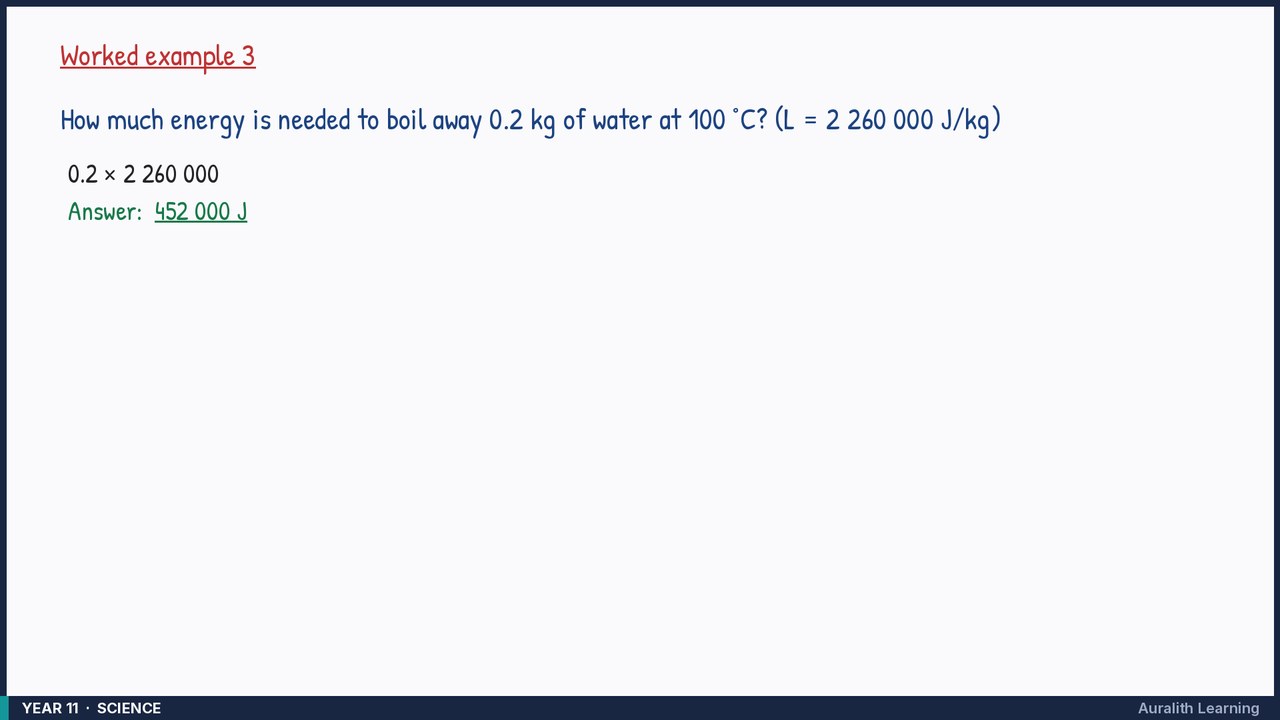
How much energy is needed to boil away 0.2 kg of water at 100 °C? (L = 2 260 000 J/kg)
- Step 1: 0.2 × 2 260 000
Answer: 452 000 J