Year 11 (ages 15–16, Grade 10 in the US) · Science · Physics: particle model and forces in matter · Lesson 1
Density and the particle model
Calculating density, measuring the density of regular and irregular objects, the particle model of solids, liquids and gases, changes of state, internal energy, and gas pressure.
Exam boards: this lesson matches the AQA and Pearson Edexcel GCSE science courses. Check which course your school follows.
9-minute video lesson
Teaching, worked examples and 20 practice questions solved step by step.
Watch free for a monthWhat your child will learn
- Use ρ = m ÷ V
- Describe how to measure density
- Explain states of matter using the particle model
- Explain internal energy and gas pressure
The method
- Density = mass ÷ volume.
- Irregular objects: measure volume by displacement.
- Solids: fixed, close particles; gases: far apart, fast.
- Heating increases internal energy (kinetic + potential).
Key words: density, particle model, internal energy, change of state, gas pressure.
Worked examples
Worked examples from the lesson, with every step.
Question 1
A block has mass 600 g and volume 75 cm³. Find its density.
- Step 1: 600 ÷ 75
Answer: 8 g/cm³
Question 2
Aluminium has density 2700 kg/m³. Find the mass of 0.5 m³.
- Step 1: 2700 × 0.5
Answer: 1350 kg
Question 3
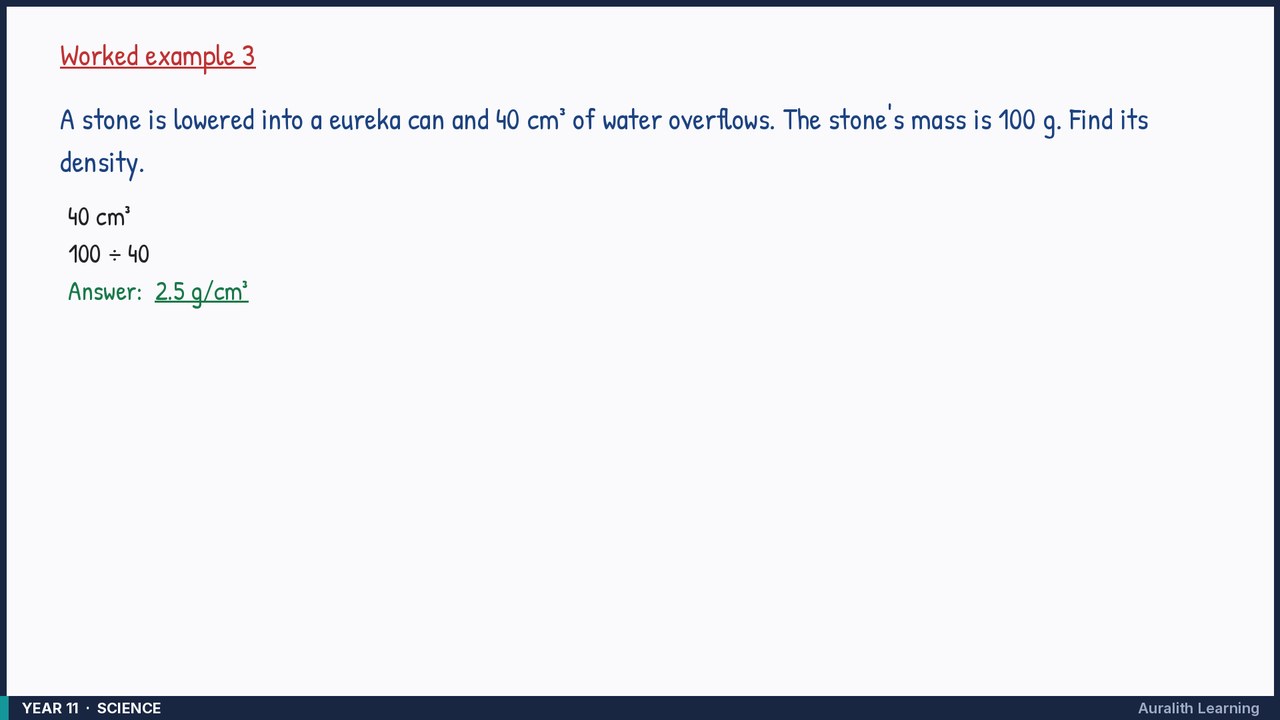
A stone is lowered into a eureka can and 40 cm³ of water overflows. The stone's mass is 100 g. Find its density.
- Step 1: 40 cm³
- Step 2: 100 ÷ 40
Answer: 2.5 g/cm³