Year 11 (ages 15–16, Grade 10 in the US) · Science · Physics: electricity · Lesson 2
Resistance and I–V characteristics
How resistance affects current, the I–V graphs of a fixed resistor, a filament lamp and a diode, and how thermistors and light-dependent resistors are used in sensing circuits.
Exam boards: this lesson matches the AQA and Pearson Edexcel GCSE science courses. Check which course your school follows.
8-minute video lesson
Teaching, worked examples and 20 practice questions solved step by step.
Watch free for a monthWhat your child will learn
- Interpret I–V graphs
- Explain why a filament lamp's resistance changes
- Describe how a diode behaves
- Explain how thermistors and LDRs are used
The method
- Ohmic resistor: straight line through the origin — constant resistance.
- Filament lamp: curve — resistance rises as it heats up.
- Diode: current flows one way only.
- Thermistor: hotter → lower resistance. LDR: brighter → lower resistance.
Key words: ohmic conductor, filament lamp, diode, thermistor, LDR.
Worked examples
Worked examples from the lesson, with every step.
Question 1
Describe the I–V graph of a fixed resistor.
- Step 1: Straight line through the origin.
- Step 2: Constant resistance.
Answer: a straight line through the origin
Question 2
Explain why a filament lamp's resistance increases.
- Step 1: Higher current heats the filament.
- Step 2: Ions vibrate more; electrons collide more.
Answer: it gets hotter, increasing collisions
Question 3
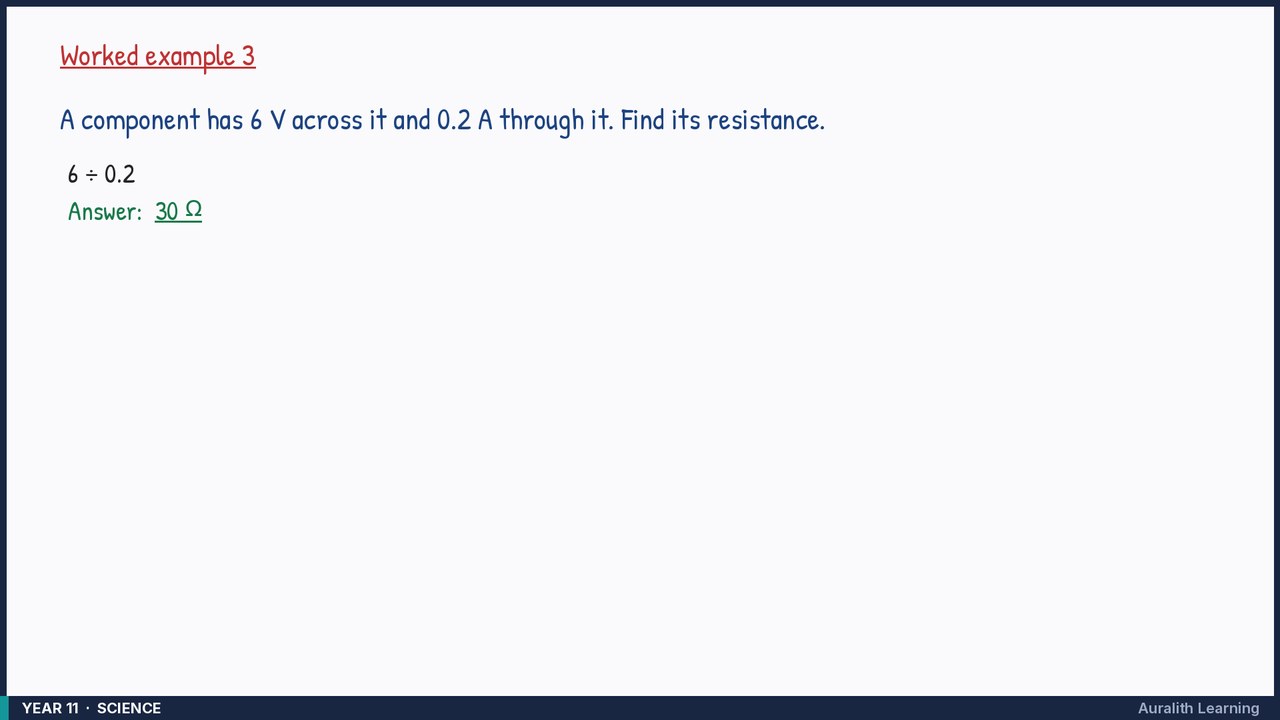
A component has 6 V across it and 0.2 A through it. Find its resistance.
- Step 1: 6 ÷ 0.2
Answer: 30 Ω