Year 11 (ages 15–16, Grade 10 in the US) · Science · Physics: electricity · Lesson 3
Power, energy transfer and mains electricity
Calculating electrical power and energy transferred, the UK mains supply, the three-core cable and safety, and how the National Grid uses transformers to reduce energy losses.
Exam boards: this lesson matches the AQA and Pearson Edexcel GCSE science courses. Check which course your school follows.
8-minute video lesson
Teaching, worked examples and 20 practice questions solved step by step.
Watch free for a monthWhat your child will learn
- Use P = IV and P = I²R
- Use E = Pt and E = QV
- Describe mains electricity and plug wiring
- Explain how the National Grid reduces losses
The method
- P = IV and P = I²R.
- E = Pt and E = QV.
- UK mains: a.c., 230 V, 50 Hz.
- Step-up transformers: high p.d., low current → less heating loss.
Key words: power, energy transferred, alternating current, earth wire, National Grid.
Worked examples
Worked examples from the lesson, with every step.
Question 1
A kettle draws 10 A from a 230 V supply. Find its power.
- Step 1: 10 × 230
Answer: 2300 W
Question 2
A 1500 W hairdryer runs for 5 minutes. How much energy does it transfer?
- Step 1: 5 min = 300 s
- Step 2: 1500 × 300
Answer: 450 000 J
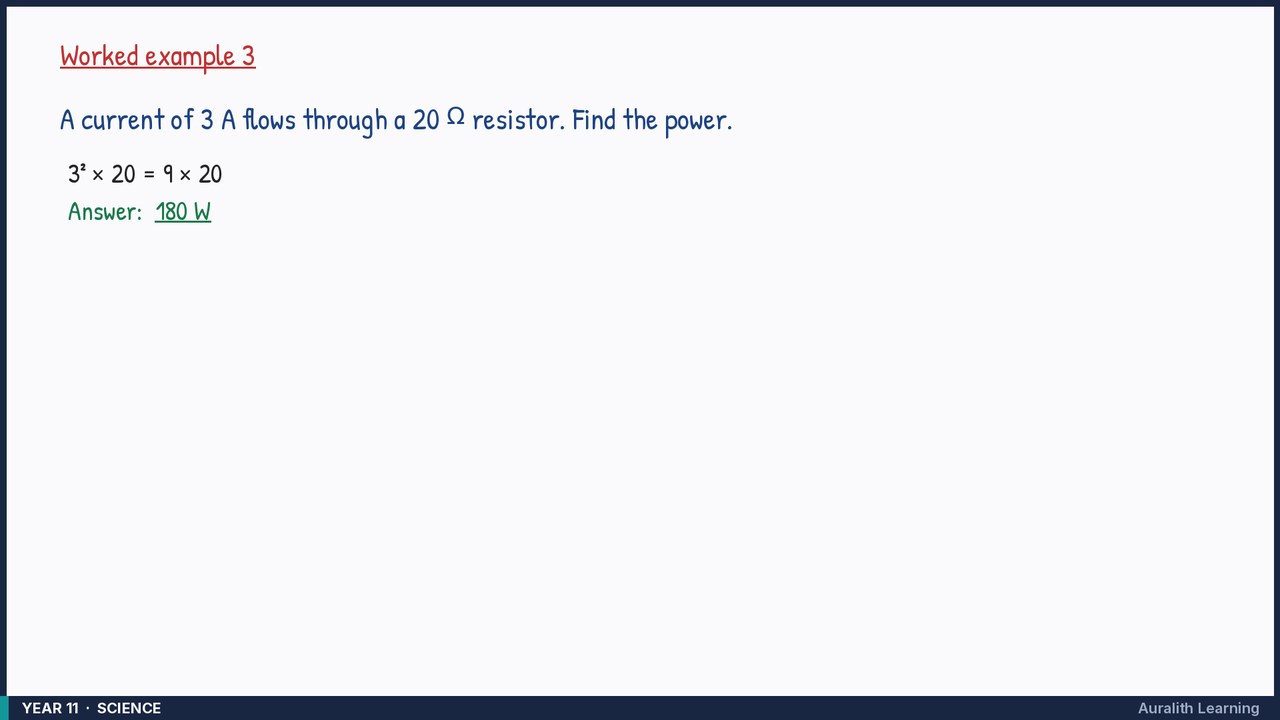
Question 3
A current of 3 A flows through a 20 Ω resistor. Find the power.
- Step 1: 3² × 20 = 9 × 20
Answer: 180 W