Year 11 (ages 15–16, Grade 10 in the US) · Science · Physics: electricity · Lesson 1
Current, charge, potential difference and circuits
Electric current as a flow of charge, Q = It, potential difference and V = IR, circuit symbols, and the rules for current, potential difference and resistance in series and parallel circuits.
Exam boards: this lesson matches the AQA and Pearson Edexcel GCSE science courses. Check which course your school follows.
8-minute video lesson
Teaching, worked examples and 20 practice questions solved step by step.
Watch free for a monthWhat your child will learn
- Use Q = It
- Use V = IR
- Apply the rules for series circuits
- Apply the rules for parallel circuits
The method
- Charge = current × time (Q = It).
- Potential difference = current × resistance (V = IR).
- Series: same current; p.d. shared; resistances add.
- Parallel: same p.d.; current splits; total resistance falls.
Key words: current, charge, potential difference, resistance, series.
Worked examples
Worked examples from the lesson, with every step.
Question 1
A current of 3 A flows for 2 minutes. How much charge flows?
- Step 1: 2 minutes = 120 s
- Step 2: 3 × 120
Answer: 360 C
Question 2
A 9 V battery drives 0.3 A through a resistor. Find its resistance.
- Step 1: R = V ÷ I
- Step 2: 9 ÷ 0.3
Answer: 30 Ω
Question 3
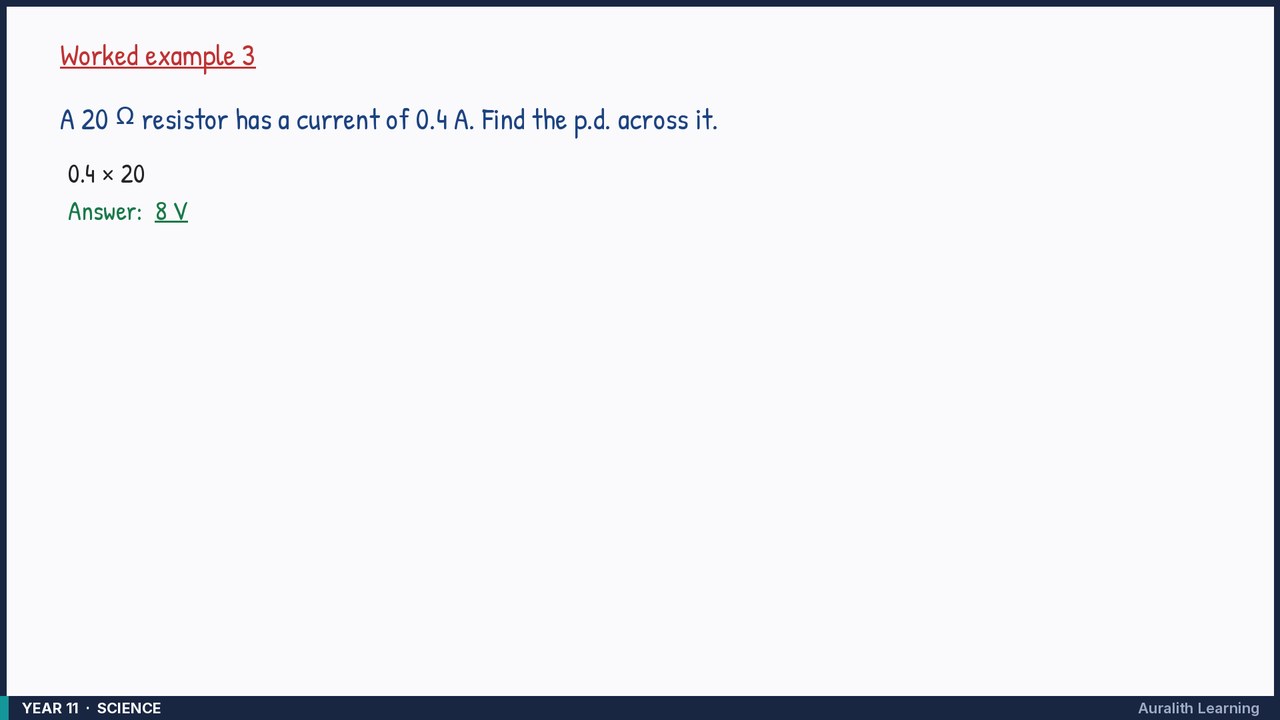
A 20 Ω resistor has a current of 0.4 A. Find the p.d. across it.
- Step 1: 0.4 × 20
Answer: 8 V