Year 11 (ages 15–16, Grade 10 in the US) · History · Elizabethan England, 1568–1603: further topics · Lesson 1
Elizabeth I, her court and her ministers
Elizabeth I's background and character, how her court worked as the centre of power, how she used patronage and royal progresses to keep loyalty, and the roles of her key ministers and favourites, including William Cecil, Francis Walsingham, Robert Dudley and the Earl of Essex.
Exam boards: this lesson matches the AQA GCSE history courses. Check which course your school follows.
9-minute video lesson
Teaching, worked examples and 20 practice questions solved step by step.
Watch free for a monthWhat your child will learn
- Describe Elizabeth's background and character
- Explain how the court and patronage worked
- Describe the roles of key ministers and favourites
- Explain how Elizabeth kept control of her court
The method
- Who was Elizabeth, and what shaped her?
- What happened at court?
- How did patronage buy loyalty?
- Who were her key ministers?
- How did she balance rival factions?
Key words: court, patronage, Privy Council, faction, progress.
Worked examples
Worked examples from the lesson, with every step.
Question 1
Describe two features of the Elizabethan court. (4 marks)
- Step 1: It was the centre of power, wherever the queen was.
- Step 2: Nobles competed for patronage such as land, titles and monopolies.
Answer: the centre of power; competition for patronage
Question 2
What was patronage, and why did it matter?
- Step 1: Rewards given by the queen.
- Step 2: Kept nobles loyal and dependent on her.
Answer: rewards like land and titles that kept nobles loyal
Question 3
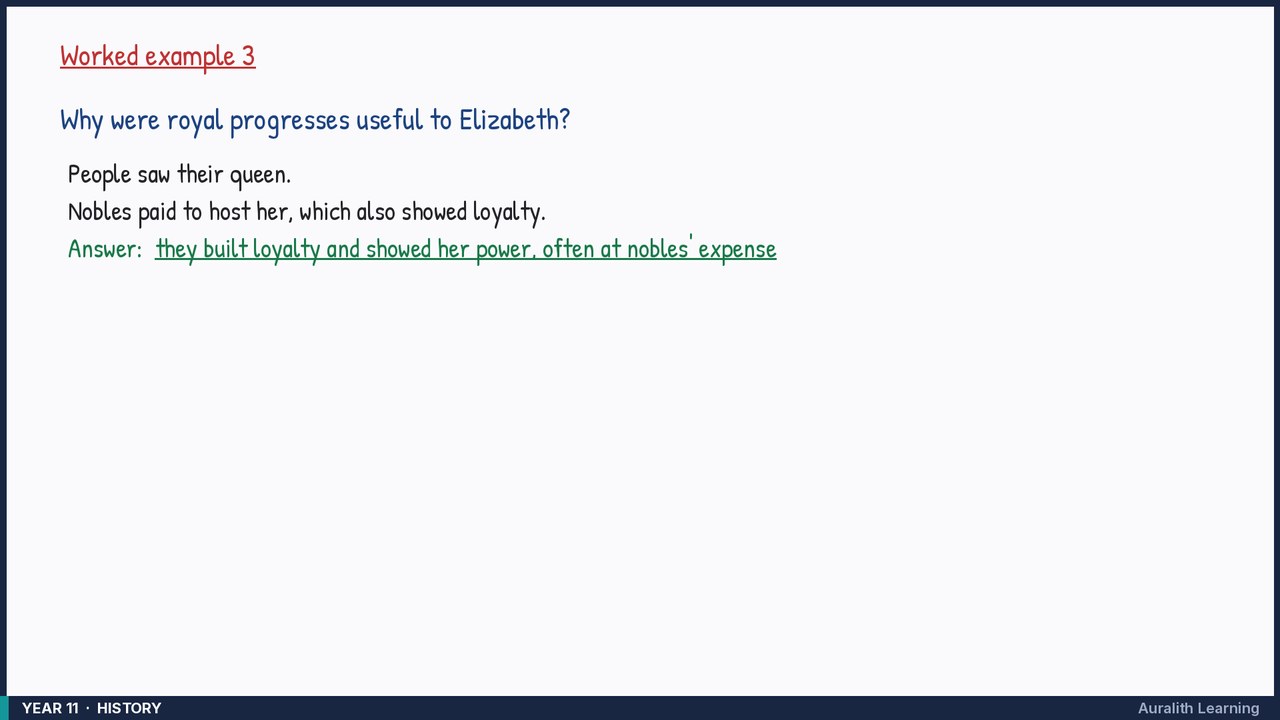
Why were royal progresses useful to Elizabeth?
- Step 1: People saw their queen.
- Step 2: Nobles paid to host her, which also showed loyalty.
Answer: they built loyalty and showed her power, often at nobles' expense