Year 11 (ages 15–16, Grade 10 in the US) · History · Elizabethan England, 1568–1603: further topics · Lesson 3
Religious matters: Catholic missionaries and Puritan challenges
How religion challenged Elizabeth after 1568: the Pope's excommunication of Elizabeth in 1570, seminary priests and Jesuit missionaries such as Edmund Campion, the government's harsh laws against them, and the Puritans who wanted further reform of the Church of England.
Exam boards: this lesson matches the AQA GCSE history courses. Check which course your school follows.
9-minute video lesson
Teaching, worked examples and 20 practice questions solved step by step.
Watch free for a monthWhat your child will learn
- Explain why the 1570 Papal Bull increased the Catholic threat
- Describe the work of seminary priests and Jesuits
- Describe the government's response to Catholic missionaries
- Explain the Puritan challenge and how Elizabeth dealt with it
The method
- What did the Pope do in 1570?
- Who were the missionaries, and what did they want?
- How did the government respond?
- What did Puritans want?
- How did Elizabeth deal with them?
Key words: excommunication, seminary priest, Jesuit, recusant, Puritan.
Worked examples
Worked examples from the lesson, with every step.
Question 1
Describe two effects of the Papal Bull of 1570. (4 marks)
- Step 1: Catholics were told they need not obey Elizabeth.
- Step 2: Catholics came under suspicion as possible traitors, and laws became harsher.
Answer: Catholics were released from obedience; they were treated with more suspicion
Question 2
What were seminary priests?
- Step 1: English Catholic priests trained abroad, e.g. at Douai.
- Step 2: Came secretly to support English Catholics.
Answer: English priests trained abroad who secretly served Catholics in England
Question 3
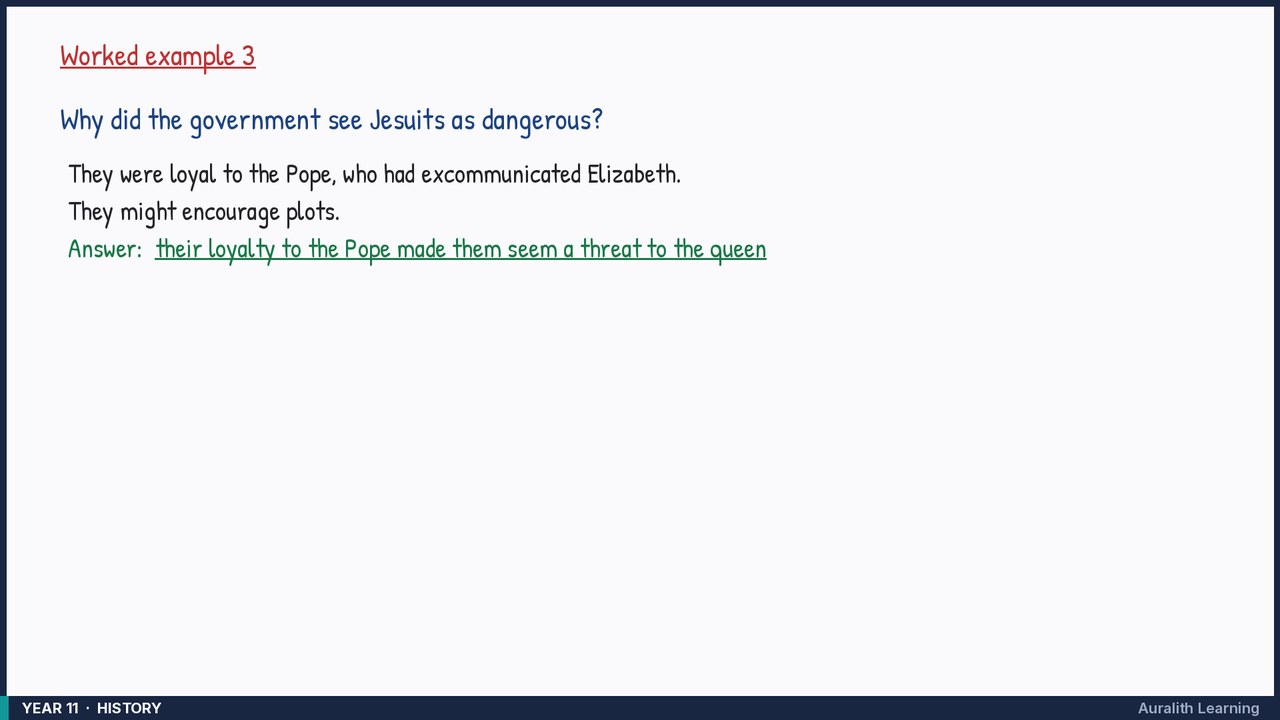
Why did the government see Jesuits as dangerous?
- Step 1: They were loyal to the Pope, who had excommunicated Elizabeth.
- Step 2: They might encourage plots.
Answer: their loyalty to the Pope made them seem a threat to the queen