Year 11 (ages 15–16, Grade 10 in the US) · Geography · GCSE human geography · Lesson 4
Measuring development
What development means, economic and social measures such as GNI per head, the Human Development Index, life expectancy and infant mortality, classifying countries as HICs, NEEs and LICs, and the demographic transition model.
Exam boards: this lesson matches the AQA GCSE geography courses. Check which course your school follows.
8-minute video lesson
Teaching, worked examples and 20 practice questions solved step by step.
Watch free for a monthWhat your child will learn
- Define development
- Use economic and social development measures
- Explain the limitations of single measures
- Use the demographic transition model
The method
- Development: improving living standards and quality of life.
- Economic measure: GNI per head.
- Composite measure: HDI (income, education, life expectancy).
- DTM: how birth and death rates change as a country develops.
Key words: development, GNI per head, HDI, infant mortality, demographic transition model.
Worked examples
Worked examples from the lesson, with every step.
Question 1
A country's GNI is $500 billion and its population is 25 million. Find GNI per head.
- Step 1: 500 000 000 000 ÷ 25 000 000
Answer: $20 000
Question 2
Why is GNI per head not always a good measure?
- Step 1: It hides inequality.
- Step 2: It doesn't show health or education.
Answer: it's an average and ignores quality of life
Question 3
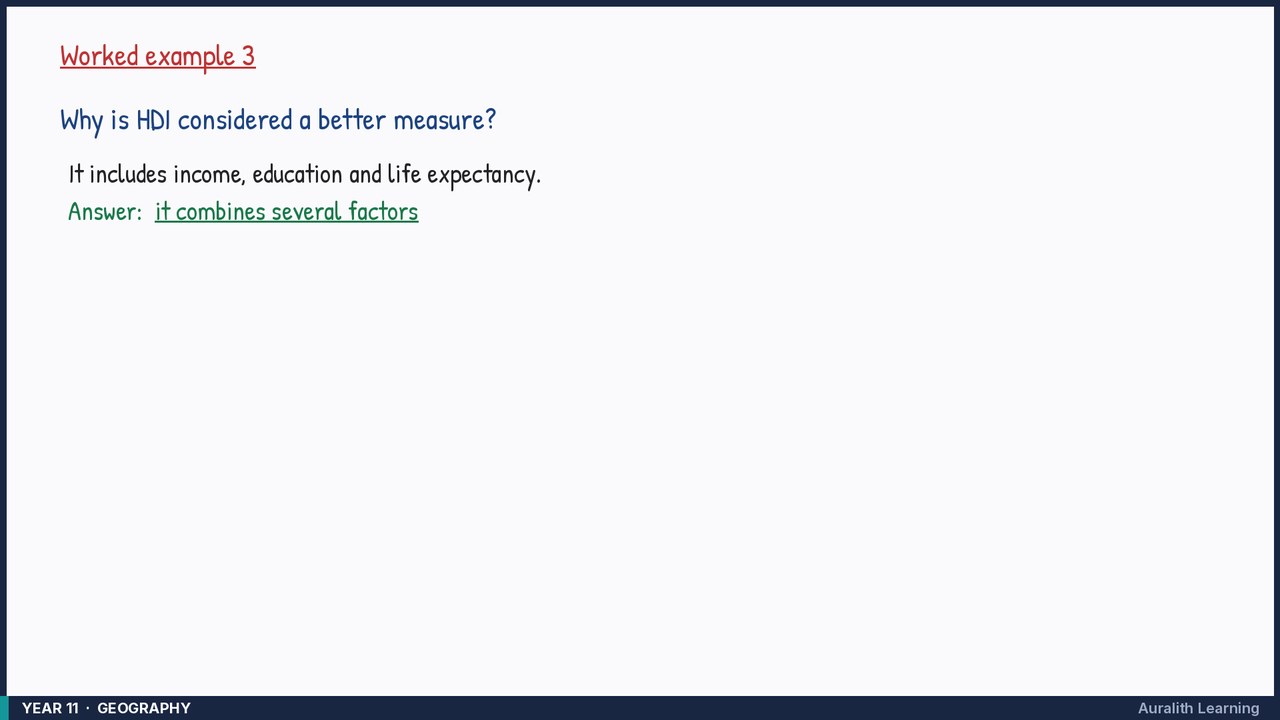
Why is HDI considered a better measure?
- Step 1: It includes income, education and life expectancy.
Answer: it combines several factors